The Reversal: Notes on Chicago as a Working System
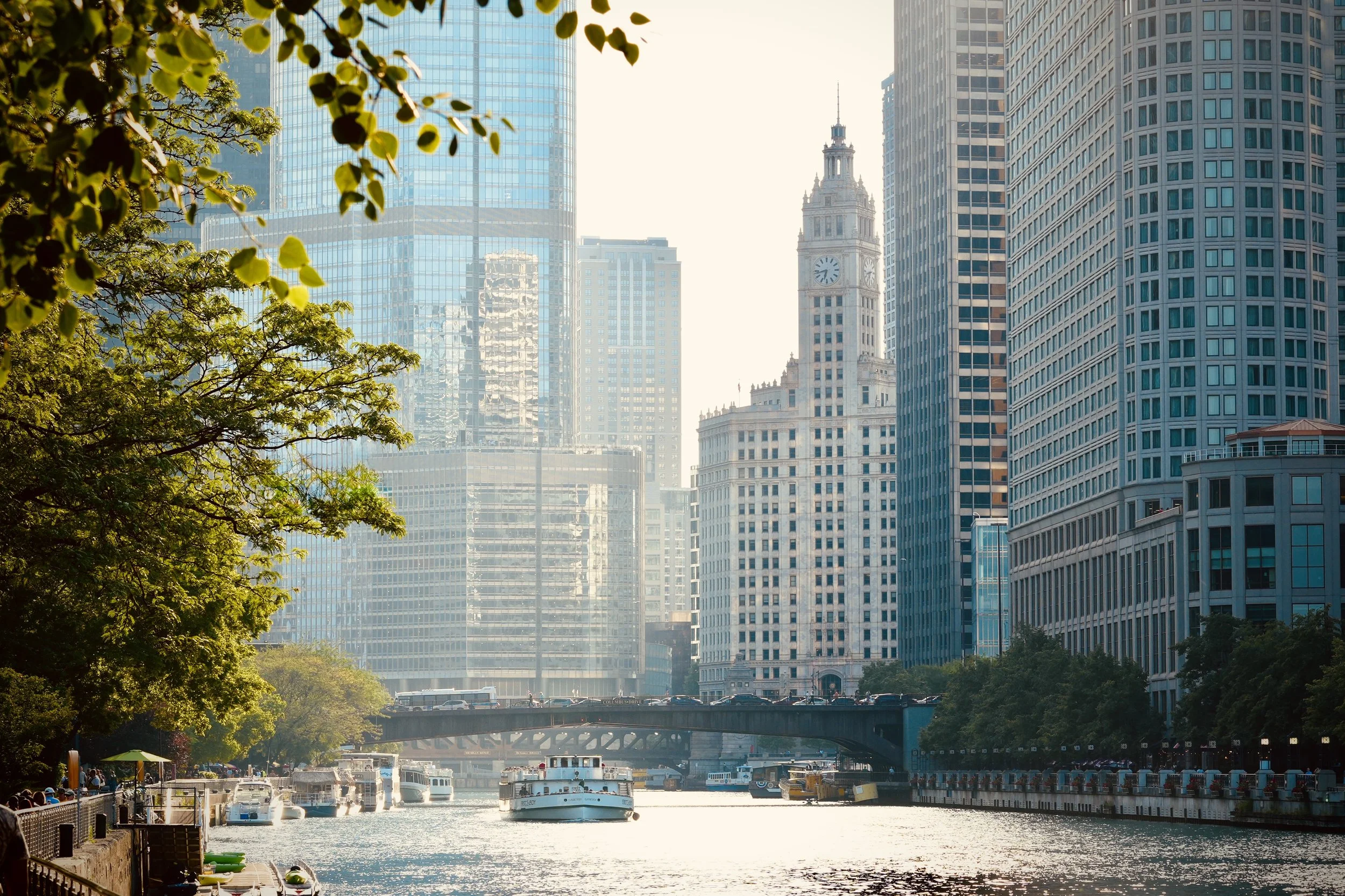
The Chicago River downtown, looking east toward Lake Michigan.
In 1900, Chicago reversed this river. The water that had flowed east into Lake Michigan since the last ice age was rerouted west, toward the Mississippi watershed, so the city would stop drinking its own sewage. It was at the time the largest civil engineering project in the country, and it remains a useful frame for everything Chicago has done since: a city defined less by what is there than by what has been adjusted.
The corridor in the photograph is the city's most-read surface. From the deck of a tour boat the river is a vertical archive — the Wrigley Building's terracotta facade (1924), the Tribune Tower's Gothic crown (1925, with embedded fragments of the Parthenon, Westminster Abbey, and a piece of the Berlin Wall added after 1989), the bascule bridges that still lift, the water taxis threading between them. The downtown's compressed architectural history — the way it documents itself in stone, steel, and glass within the space of a single sightline — is partly a function of fire. After the city burned in 1871, it had to rebuild from nothing, and what it built were the modern world's first skyscrapers. The river became their lobby.
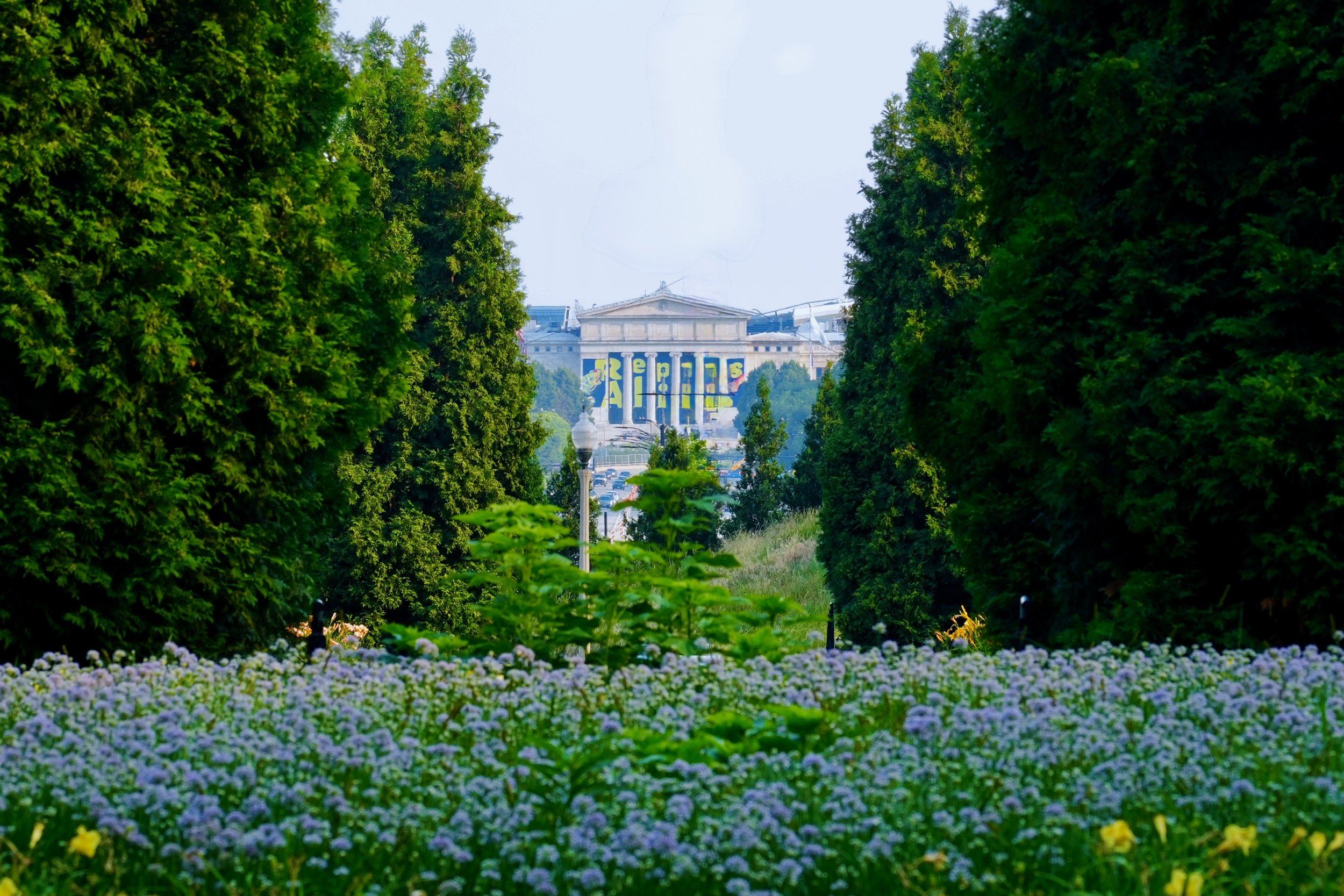
The Field Museum, seen through Lurie Garden.
The same adjustment is visible at smaller scales. Lurie Garden, opened in 2004 as part of Millennium Park, sits on five acres above what used to be a railyard and a parking structure. Its planting plan is mostly native tallgrass prairie — coneflowers, prairie dropseed, switchgrass — set in tight allées that read more like a cornfield than a meadow. From the right angle, in late summer, the Field Museum frames itself between the stalks. The garden is doing what most of Chicago's recent green space does: not retreating from the city but threading the prairie back through it, on the city's own terms.
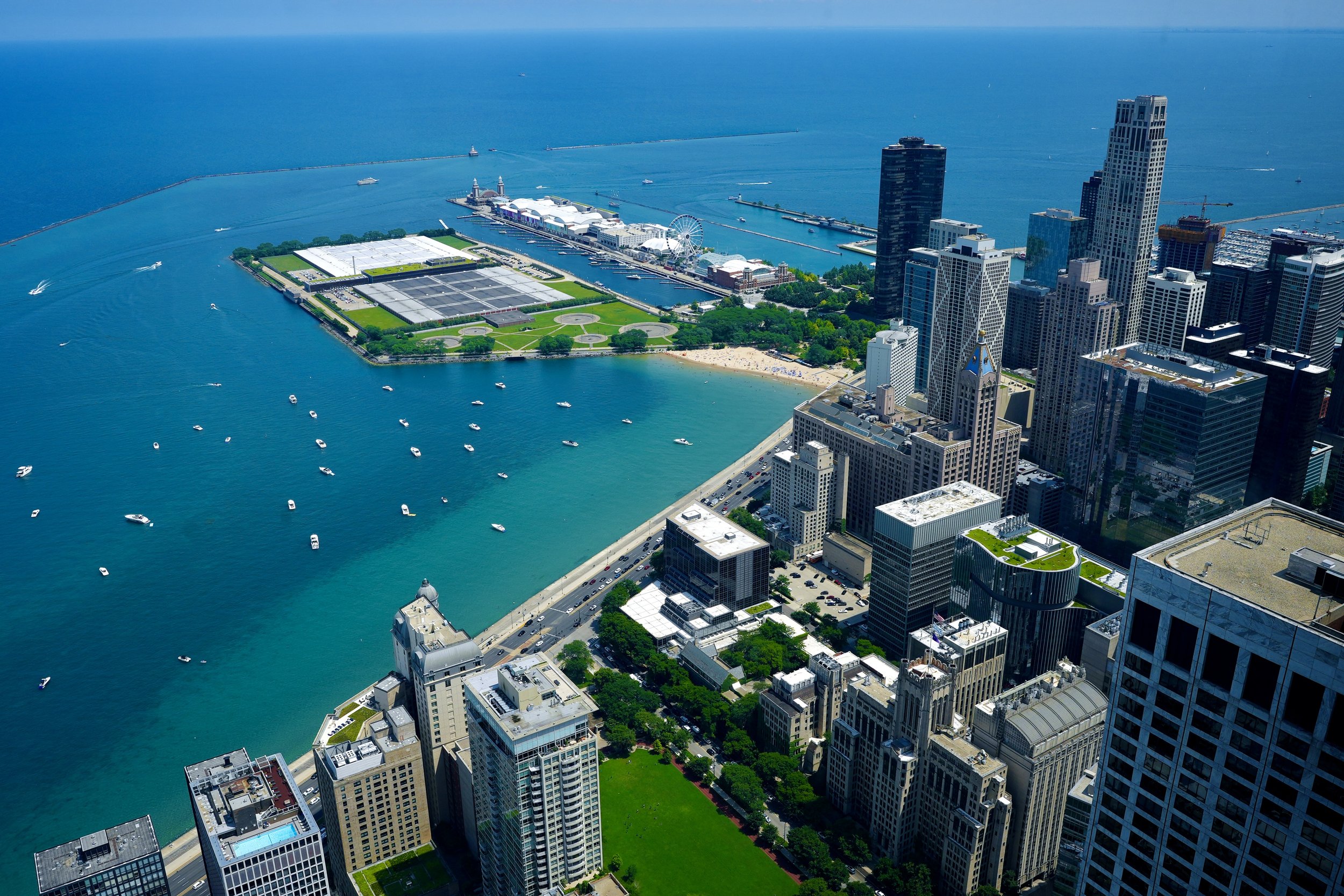
Navy Pier and the Jardine Water Purification Plant, from 360 Chicago.
From above, the system becomes legible. The dark rectangles next to Navy Pier — the building no one photographs but everyone drinks from — are the Jardine Water Purification Plant, one of the largest water treatment facilities in the world by volume, processing roughly a billion gallons a day from intake cribs two miles out into the lake. The beach beside it isn't a vestige of original shoreline; almost none of the lakefront is. The land east of Michigan Avenue, including all of Grant Park, the Museum Campus, and Navy Pier itself, sits on landfill engineered into the lake across the late nineteenth and early twentieth centuries. The aerial makes clear what the street obscures: the lake's edge is a built object.
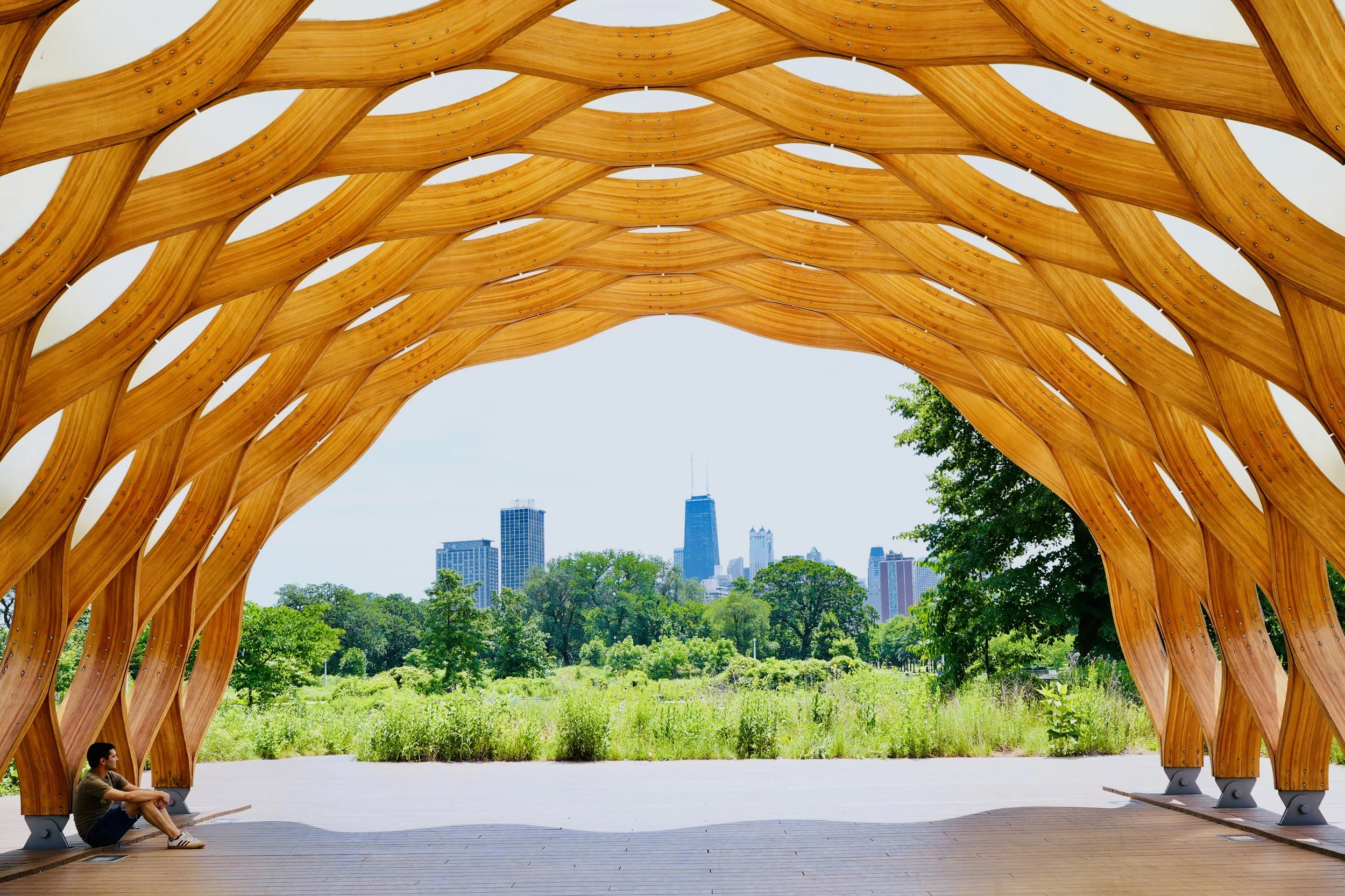
The Education Pavilion at Lincoln Park Zoo's South Pond, with the John Hancock Center beyond.
Lincoln Park, three miles north of the Loop, is where the negotiation gets most explicit. The South Pond was originally a livestock watering hole, then a paddleboat lagoon, then — in 2010 — a restored wetland with a parametric wooden pavilion by Studio Gang. The arches above the boardwalk are made of bent laminated wood in a tortoise-shell pattern; the wetland below is now habitat for Canada geese, herons, beavers, and red-winged blackbirds. The geese, especially, were never the problem Chicago's planners once thought they were. They cohabit. The pavilion frames the skyline as if to admit that the city is the landscape too — that the Hancock, four miles south, is part of the ecology now.
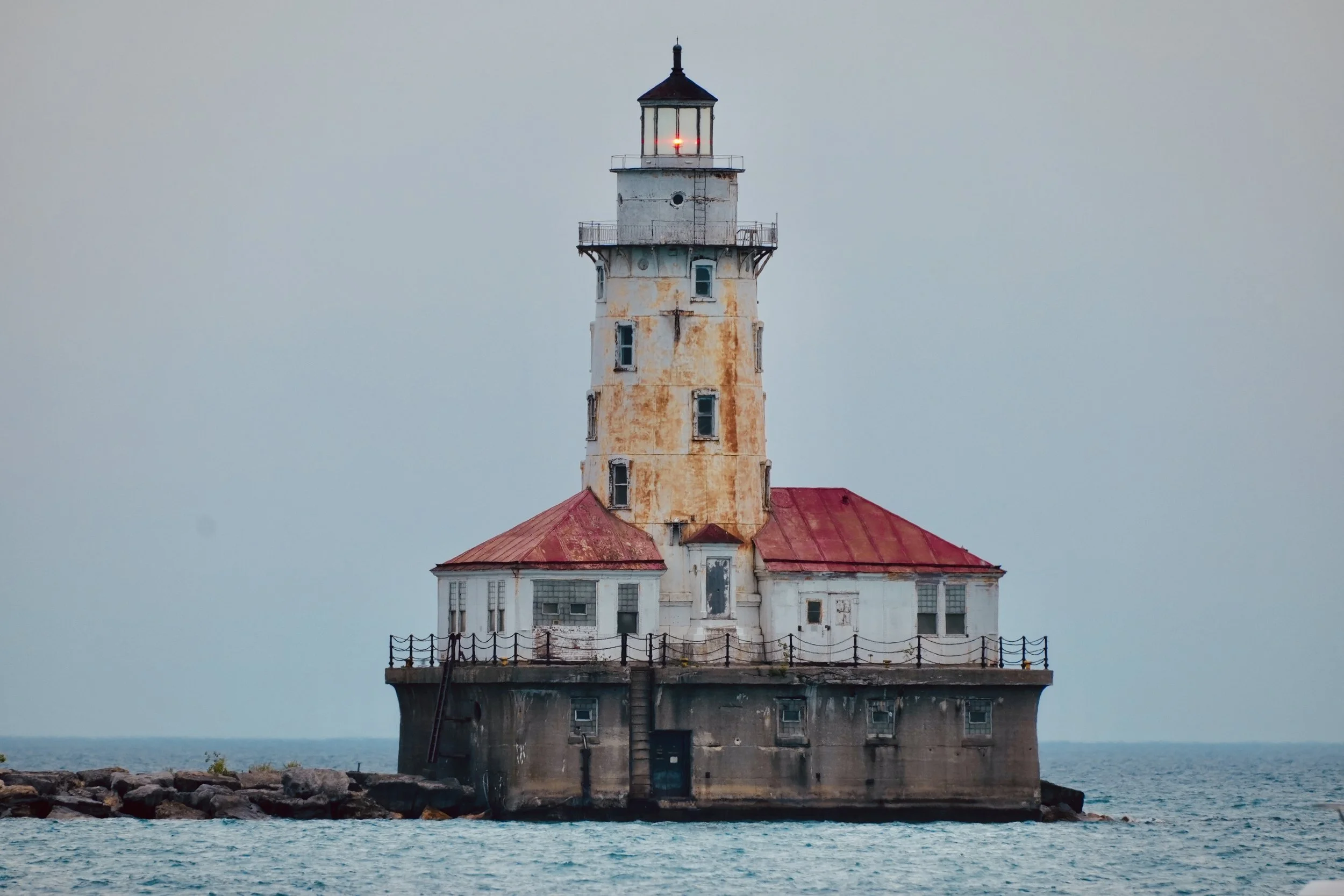
Chicago Harbor Lighthouse, automated since 1979.
Not everything the city built still works the way it was meant to. The Chicago Harbor Lighthouse, originally constructed in 1893 for the Columbian Exposition and relocated in 1919 to its present breakwater, was decommissioned as a manned station in 1979 and has run automatically ever since. The Coast Guard owns it; no one lives there. From a distance it reads as monumental — an upright object alone on a horizontal — and up close it reads as ruin, the iron roof rust-streaked, the limestone discolored where the lake has been working on it for a century. It is the rare Chicago structure honest about what time does to engineered things.
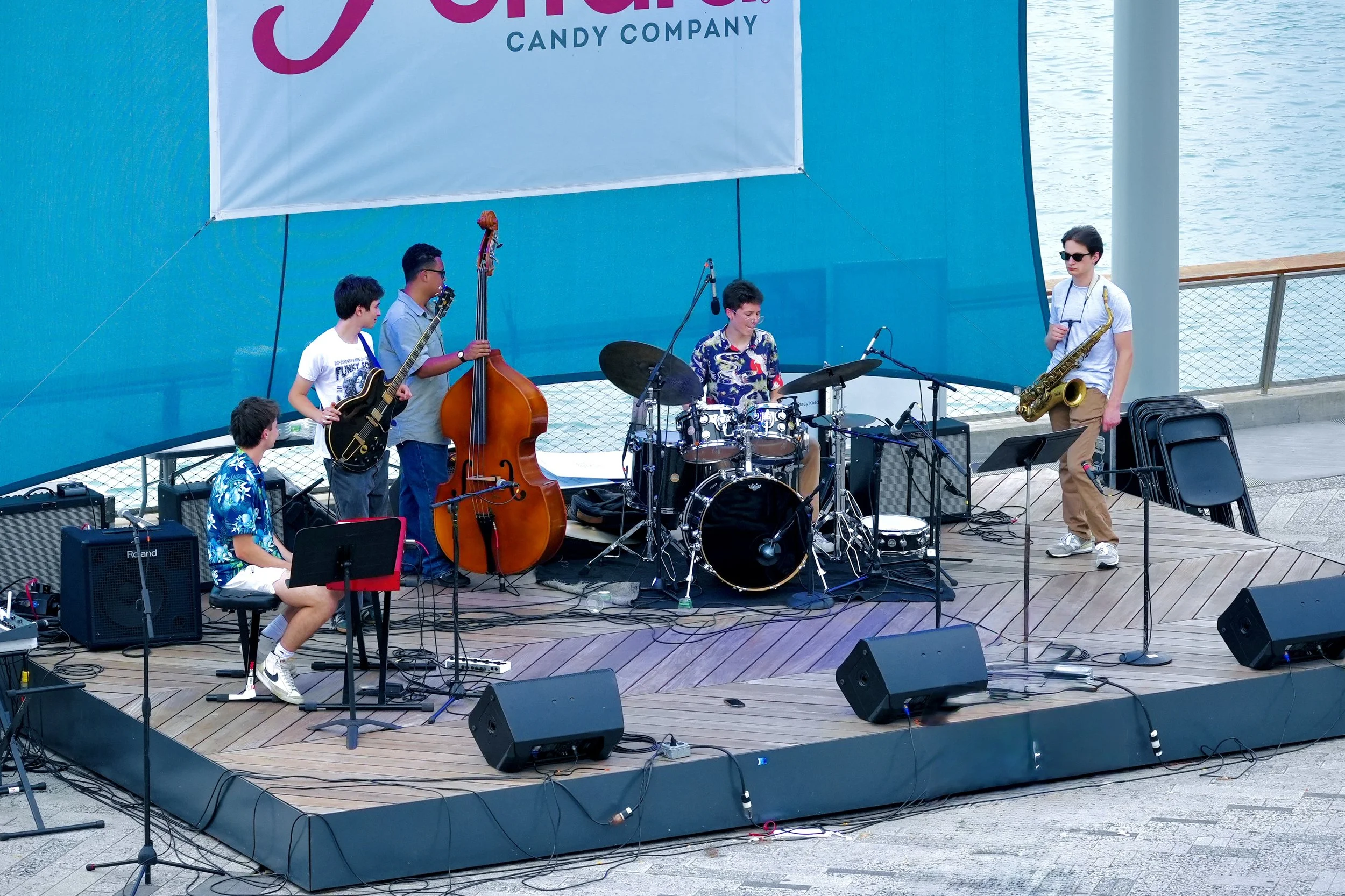
A young jazz quintet plays Polk Bros Park at Navy Pier.
Navy Pier is older than most of what it now contains. Built in 1916 as Municipal Pier — freight terminal, transit hub, and public promenade simultaneously — it has since served as a naval training facility, a University of Illinois campus, and, since the 1990s, the most-visited tourist site in the Midwest. The 2016 renovation added Polk Bros Park, where on a Sunday afternoon a high school jazz quintet plays standards under a Ferrara Candy Company banner, with the South Loop's newer towers — St. Regis, Aon, Willis — compressed into the backdrop. Free programming sponsored by a local confectioner is its own kind of civic argument: the pier sustains itself by remaining legibly public.
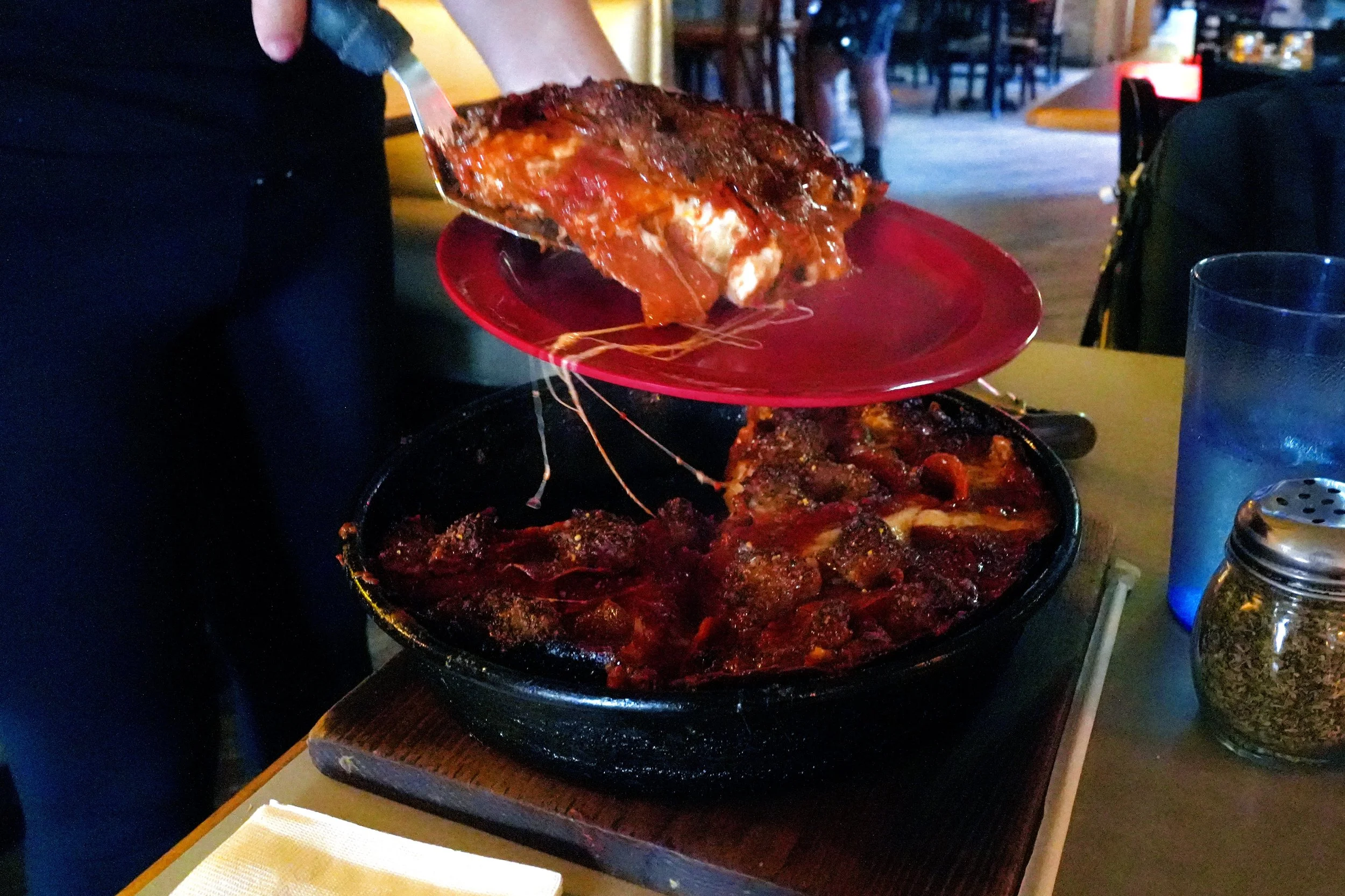
slice of Pequod's deep dish, with the caramelized cheese crust that became its signature.
The food map of Chicago is also a map of how immigrant economies metabolized into neighborhood ones. Pequod's, on North Clybourn in Lincoln Park, opened its city location in 1992 but traces back to a Morton Grove pizzeria from 1971. The signature isn't the deep dish, which Chicago invented in 1943 at Pizzeria Uno; it's the caramelized cheese ring that forms where the mozzarella runs down and meets the seasoned cast iron. The slice in the foreground is, technically, burnt — which is to say, it's the entire reason the place exists. Italian-American food in Chicago has spent eighty years finding ways to commit to its own excess.
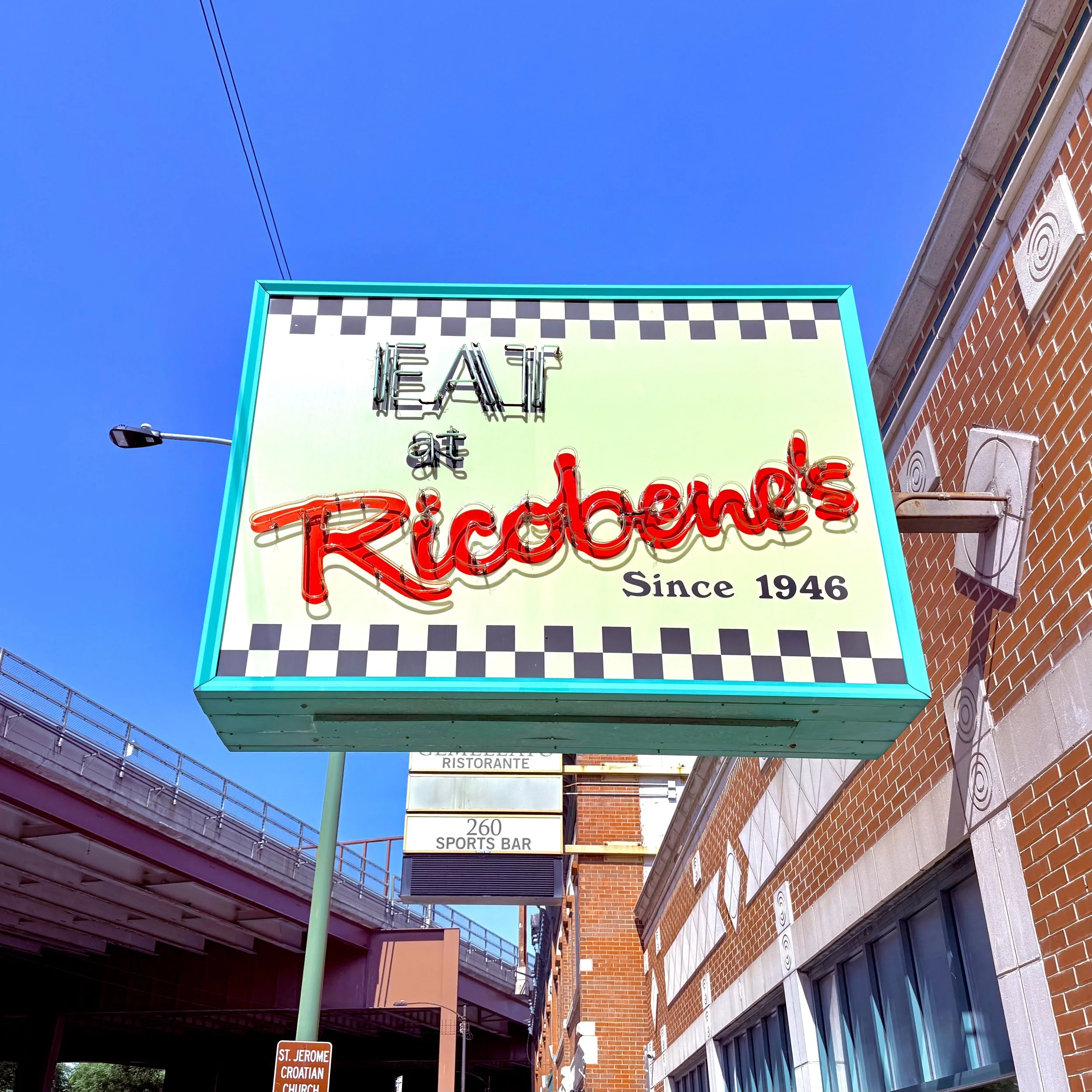
Ricobene's, on West 26th Street, Bridgeport.
Three miles south, in Bridgeport, Ricobene's has been making the breaded steak sandwich since 1946. The neighborhood around it has changed three times — first Italian, then Italian-and-Mexican, now mixed in ways that reflect the wider South Side — but the sandwich hasn't. It is breaded round steak on Italian bread, drowned in marinara, sometimes finished with mozzarella. It arrives wrapped in foil. The wrapper says EAT AT RICOBENE'S. A neighborhood food can outlast its neighborhood, in Chicago; the building outlasts the people who built it; the recipe outlasts the building. Continuity is one of the city's quieter engineering feats.
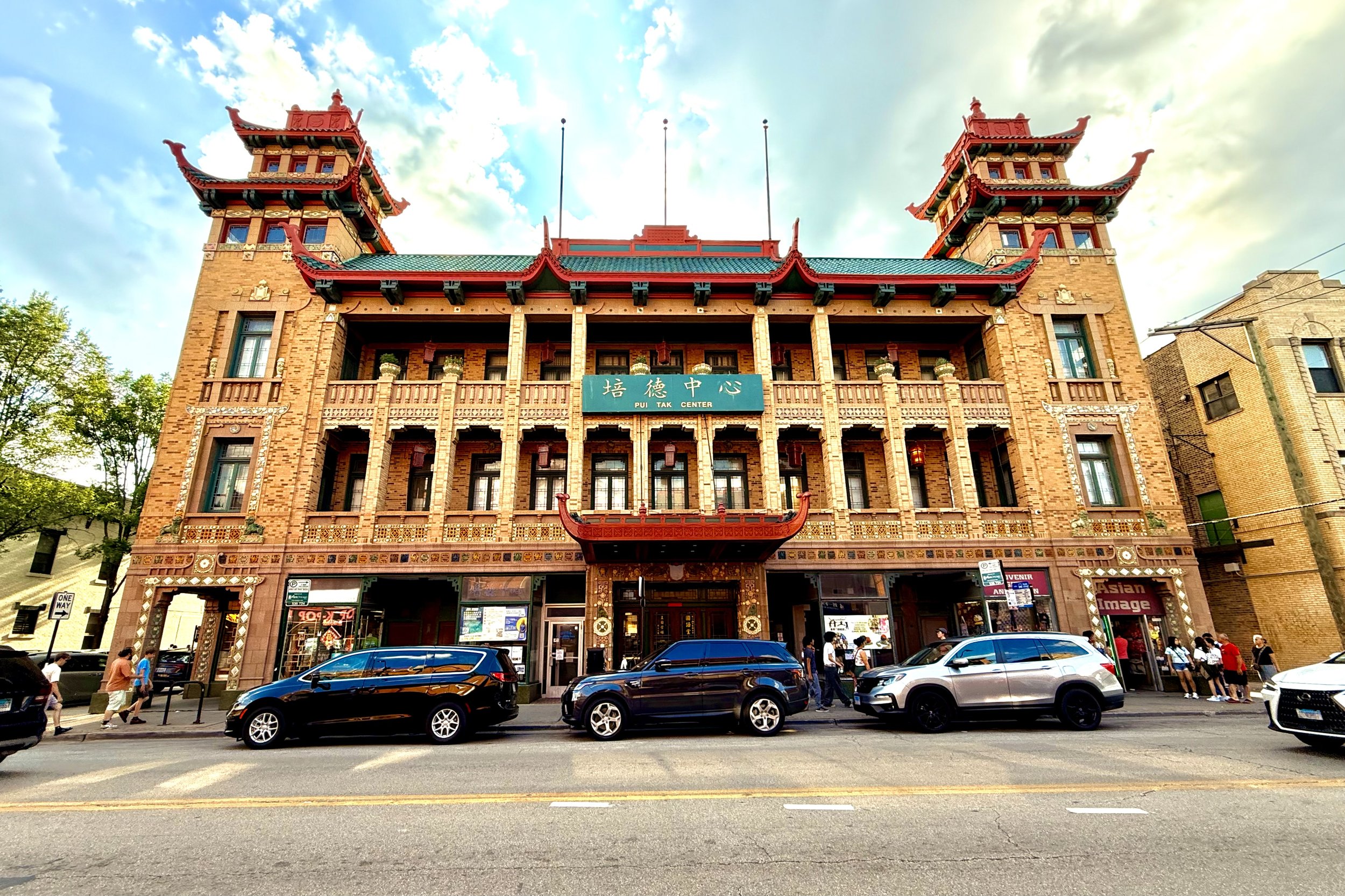
The Pui Tak Center on Wentworth Avenue, originally the On Leong Merchants Association Building (1928).
Chinatown, another mile south on Wentworth, is one of the few Chinatowns in the country that has grown rather than contracted over the last forty years. Its architectural anchor is the Pui Tak Center, a 1928 building by Michaelsen & Rognstad designed as the headquarters of the On Leong Merchants and Laborers Association — the organization that operated as Chinatown's de facto local government for decades. The polychrome terracotta, the pagoda finials, the green-glazed tile: all of it is a building arguing for legitimacy in a city that was not always interested. It now houses a Chinese Christian community center, English-language classes, after-school programs. The block around it stacks economies the way the building stacks roofs — Chiu Quon Bakery (1986) two doors down, Legend Tasty House (2016) two doors the other way, a food court underneath them serving hand-pulled noodles and lamb skewers with signage in three writing systems.
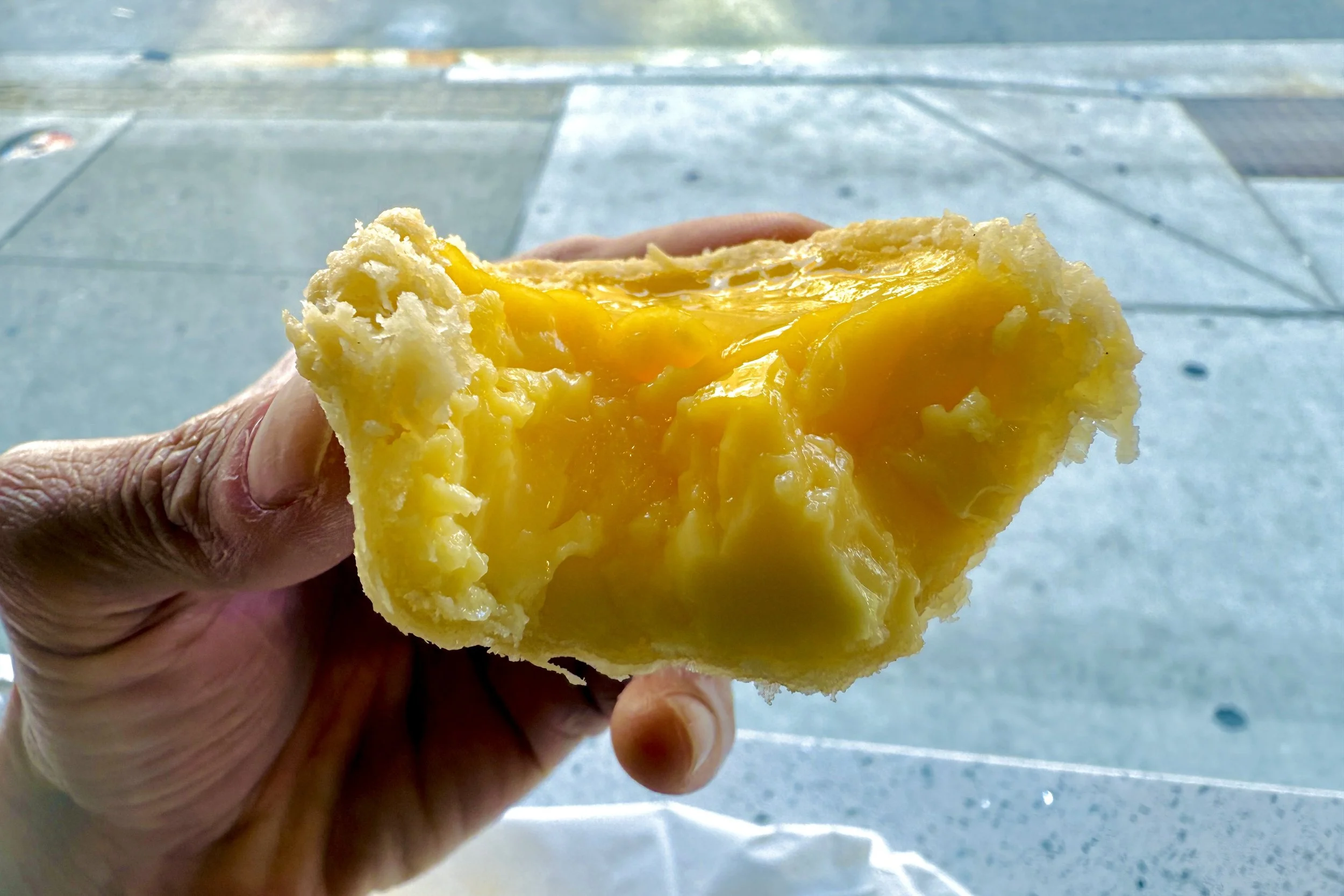
An egg custard tart at Chiu Quon Bakery, since 1986.
The egg tart is a compressed historical document. Its shell is short pastry — Portuguese, by way of Macau, by way of Hong Kong, by way of the migration that brought the recipe to Wentworth Avenue in the 1980s. The custard is unmistakably British: a Hong Kong adaptation of a colonial-era pastry shop. The two-bite size and the foil cup are American conveniences. Chiu Quon's case holds fifty other versions of this kind of object — coconut buns, melon pan, BBQ pork buns, sticky rice steamed in lotus leaf — each a fork in a different migration history. Three doors down, a rolled-ice-cream shop staffed by visibly twenty-something workers freezes oat milk on a steel plate to a Cantopop track, and the line is out the door. The neighborhood's argument is simple, and the city is built on versions of it: continuity and reinvention are not opposed.
Chicago is a city that solves itself in public. The river was running the wrong way, so it was reversed. The prairie was paved, so it was replanted. The lake had no beaches, so they were engineered. The immigrant neighborhoods were unwelcome, so they built their own civic infrastructure and kept making the food. None of these are finished projects. The egg tart in the bakery case and the laminated arch over the wetland and the lighthouse alone on its breakwater are the same gesture at different scales: a city continuously negotiating with the conditions it inherited, and producing, as a byproduct, the things people come to look at.
To see more photos & videos from my travels visit the links below
happy traveling,
~Sean
