Koh Phayam: Try Again
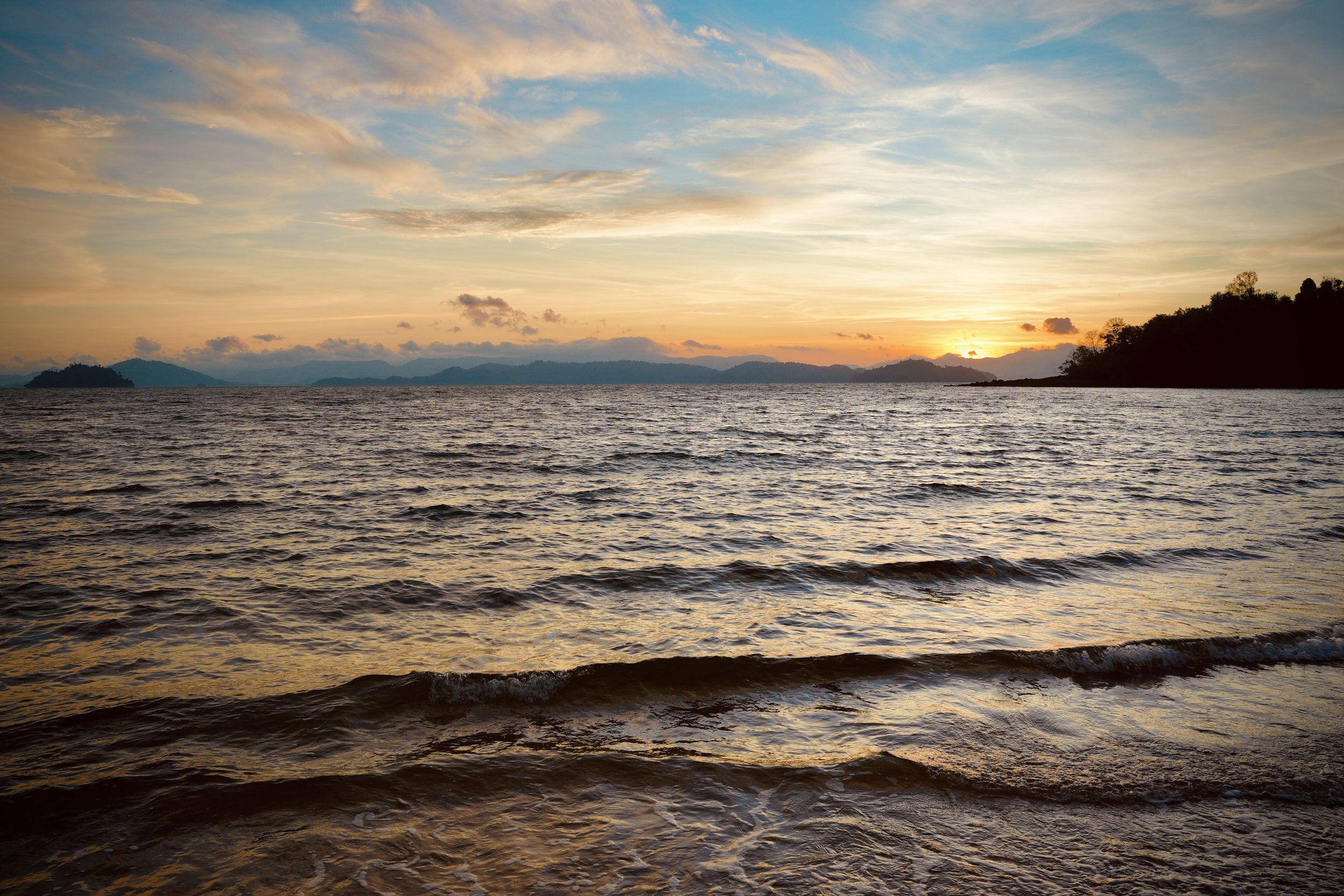
Sunset over the Andaman Sea from Koh Phayam's western beach. The mountains on the horizon are Myanmar. This is what the end of the day looks like when nothing has been built to interrupt it.
Getting to Koh Phayam requires a decision. Thirty kilometers off the coast of Ranong — Thailand's wettest province, pressed against the Myanmar border in the far north of the Andaman Sea — the island does not announce itself. There are no direct flights. The speedboat takes forty minutes; the local ferry takes two hours. Either way, you arrive by water, watching the island's forested hills emerge from the haze, and either way you understand immediately that you have arrived somewhere that has not yet been optimized for arrival.
The island is roughly ten kilometers long and five wide, home to around 500 permanent residents — fishermen, farmers, a small Moken community, a handful of people who came for a week and stayed for a decade. There are no cars. Dirt paths and narrow concrete roads connect the beaches to the interior. Cashew nut trees and rubber plantations cover the hillsides that tourism hasn't yet reached. The name Koh Phayam is thought to derive from the Thai word phayayam — "try again" — from the days of sail when small vessels sometimes had to attempt the crossing more than once if the wind ran against them. It is the kind of name that suits a place that does not make things easy.
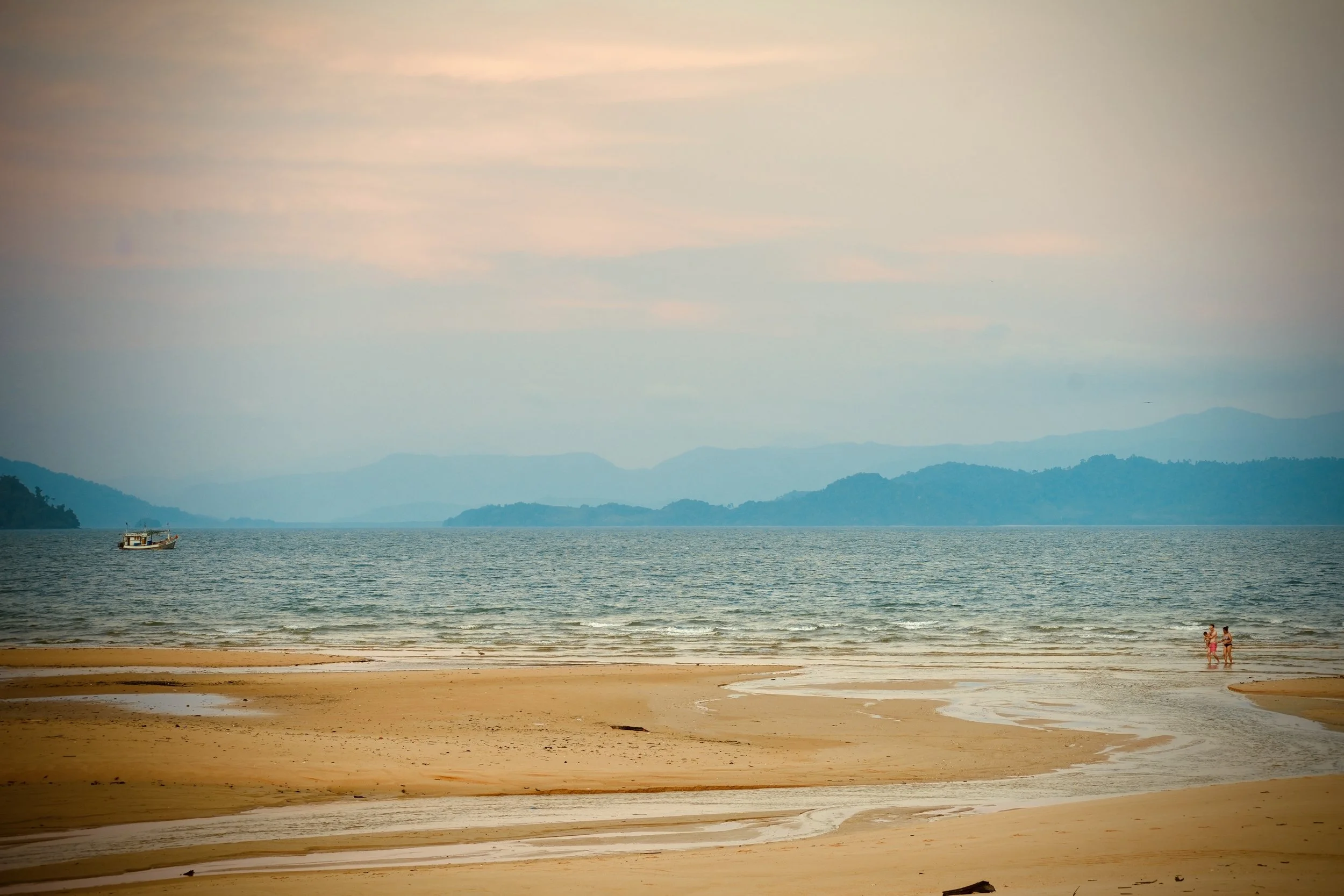
Low tide on the western beach. Two figures at the water's edge, a fishing boat on the horizon, and the mountains of Myanmar fading into haze. Scale without drama.
Seen from the beach at low tide, the island's logic becomes clear: a wide sweep of pale sand between dense forest and the Andaman Sea, the water shallow enough to wade far out before it deepens, the horizon lined with the silhouettes of other islands and the distant mainland coast. There is nothing on this beach that wasn't here twenty years ago except the footprints. Phuket, an hour south by air, receives more than ten million visitors a year. Koh Phayam receives a fraction of that — backpackers and long-termers and eco-tourists who found it and couldn't entirely leave. The island's lack of an airport is not an oversight. It is, effectively, a filter.
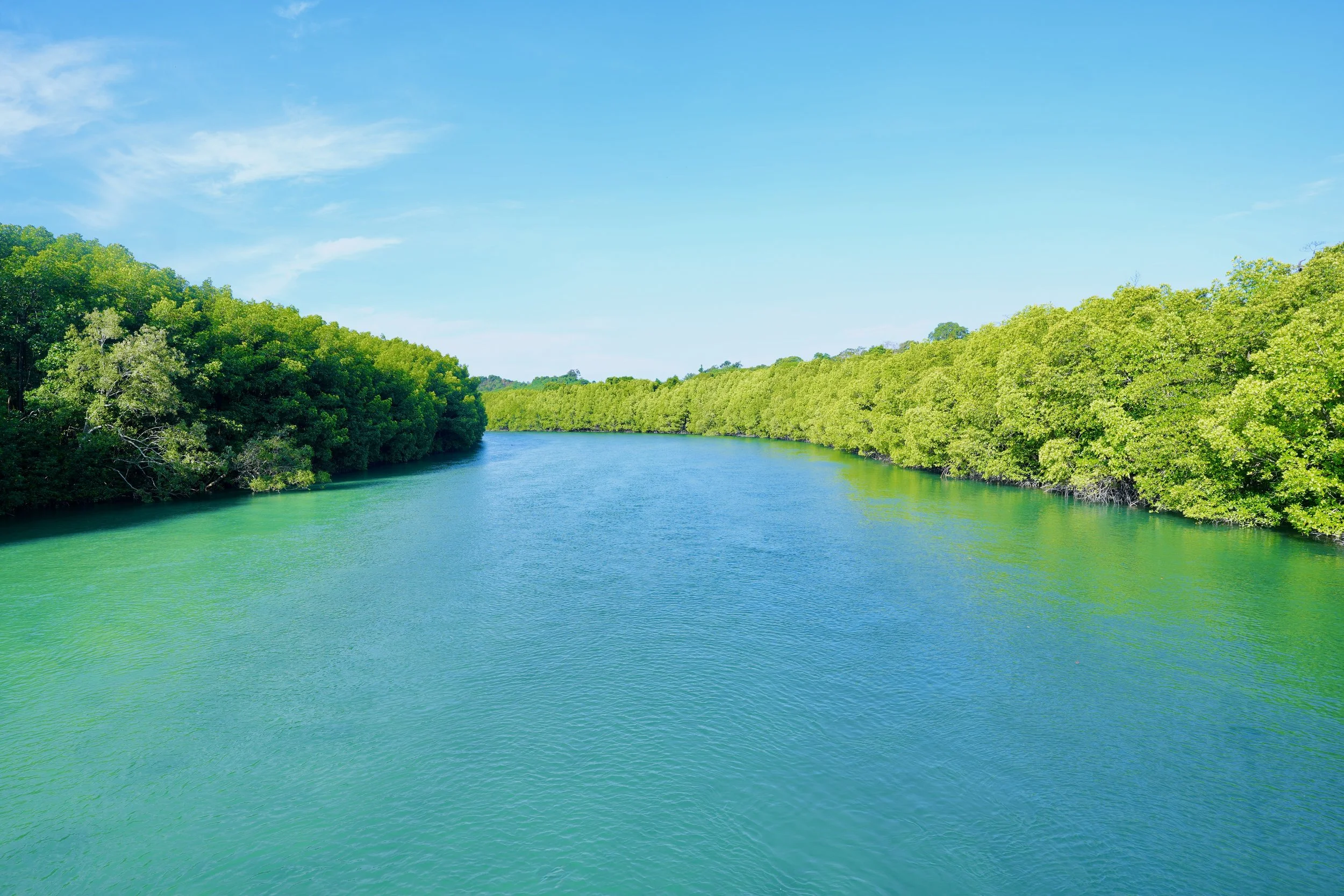
The mangrove channel that cuts through the island's interior. Mangroves cover roughly a third of Koh Phayam's coastline — nursery, filter, and flood barrier, doing the work that no infrastructure budget could afford.
The mangroves are the island's most important system, and the least visible to anyone who arrives looking for beach. They line the inner channels and the protected bays, their roots tangled into the brackish water in a structure so dense and interconnected that separating individual trees from the whole becomes meaningless. Mangrove forests are among the most productive coastal ecosystems on earth — nursery grounds for juvenile fish, carbon sinks, buffers against storm surge. Koh Phayam's mangroves cover roughly a third of its coastline. They are why the fishermen have fish. They are why the beaches haven't eroded. They are doing, quietly and continuously, the work that no infrastructure budget could afford to replicate.
The fishing boats move through the channels in the morning, their engines audible before they appear around the bend in the mangrove wall, the mountains of the mainland blue and distant behind them. It is the oldest pattern on this coast — boats moving through green water toward the open sea, the same movement repeated every morning for as long as there have been people here.
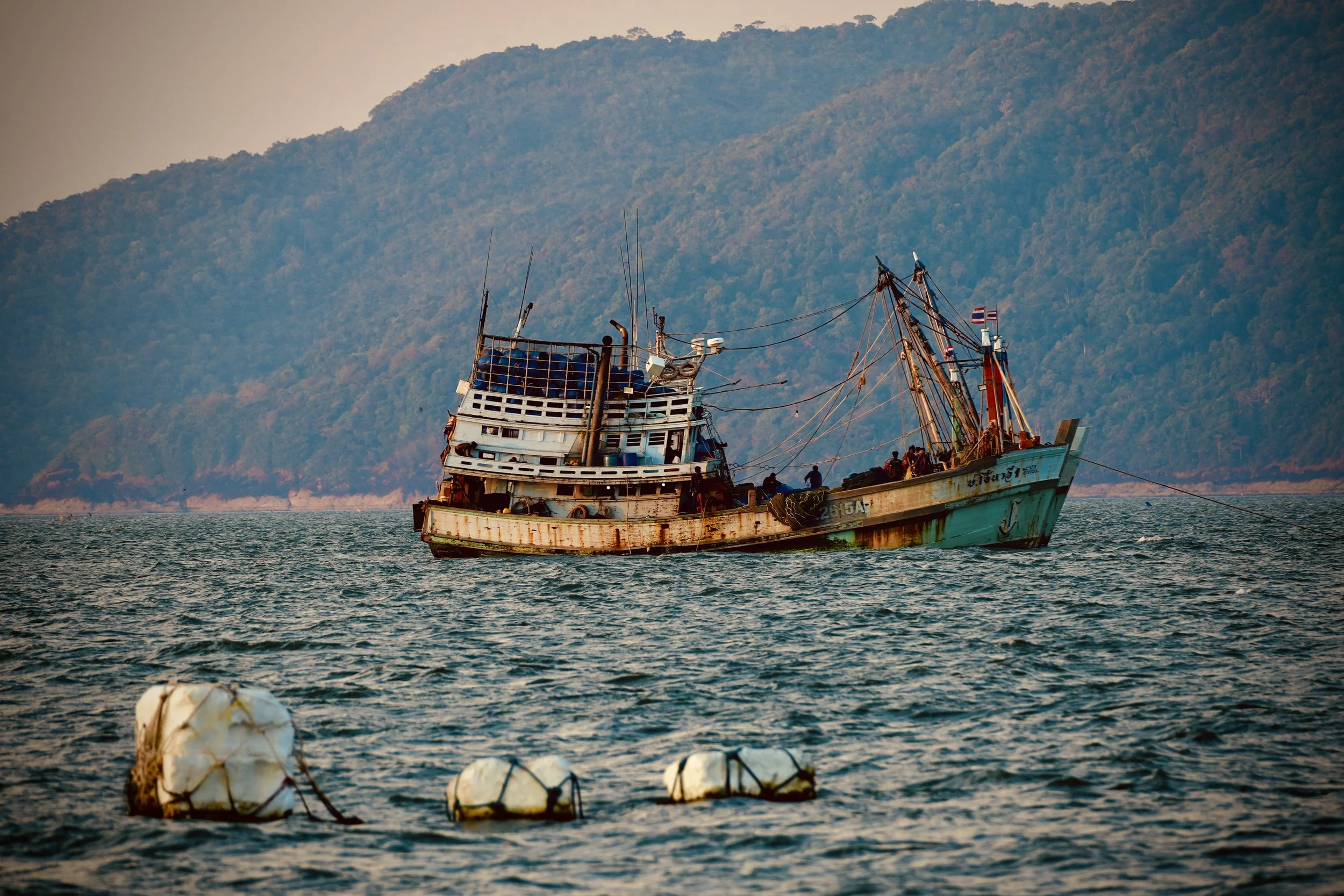
A working trawler in the Andaman Sea off Koh Phayam. The fishing economy here predates the tourism economy by centuries and will likely outlast it.
The sea is the island's oldest employer. The fishing trawlers that work these waters are heavy, salt-worn vessels — the kind that carry a week's worth of provisions and come back low in the water. They are not picturesque in the way that longtail boats are picturesque. They are functional, and their functionality is the point. The Andaman Sea off Ranong province is among the most biodiverse marine environments in Thailand, its waters fed by the monsoon runoff from some of the wettest land in the country.
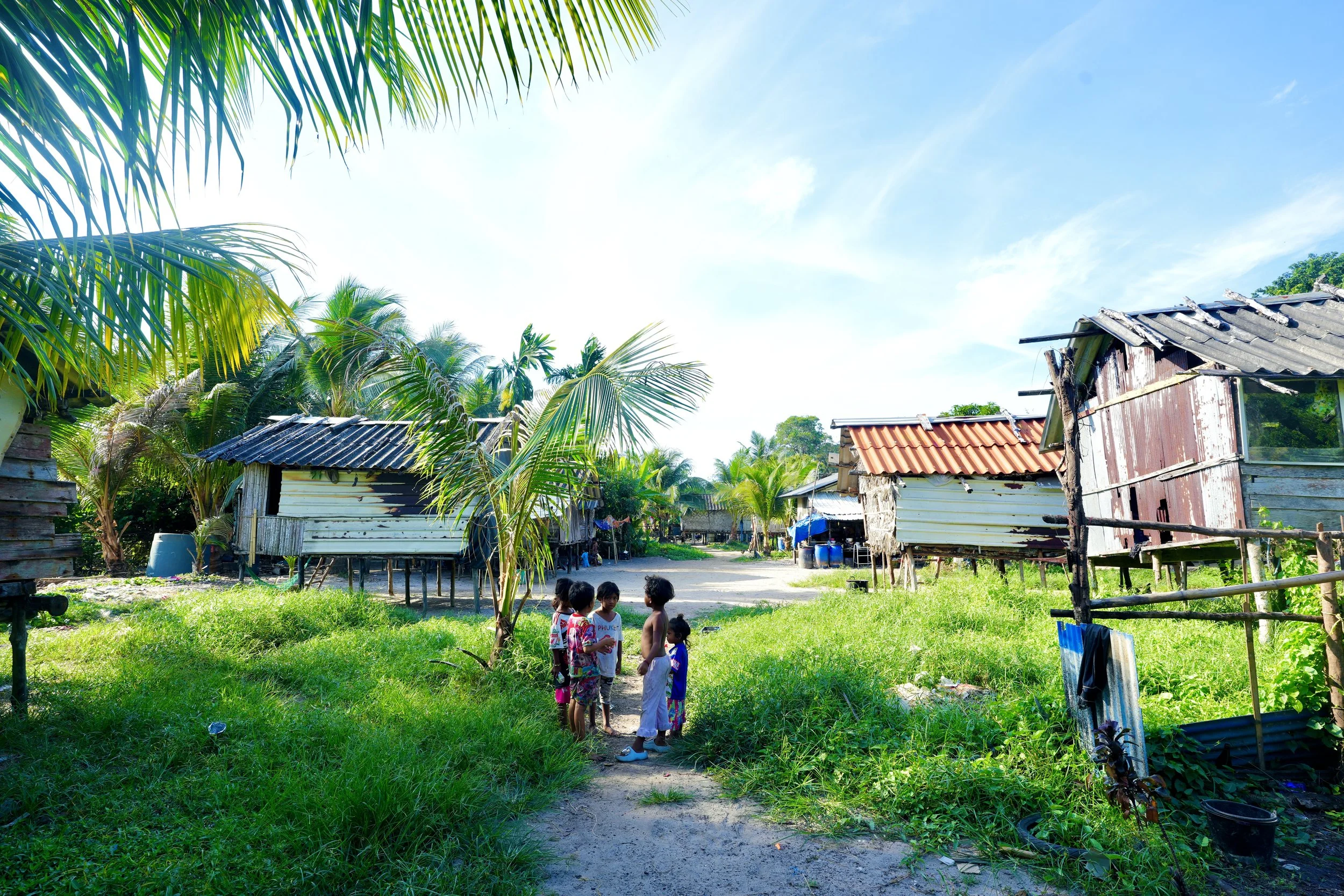
he Moken village on Koh Phayam — stilt houses, palm trees, red iron roofs. Around 160 people, 45 families, one of the last semi-nomadic sea peoples of the Andaman.
At the lower end of the island's western bay, the Moken village sits back from the water in a cluster of wooden stilt houses under palm trees. There are around 160 people here — 45 families, approximately 50 children under fifteen. The Moken are an Austronesian people who have inhabited the islands and coastlines of the Andaman Sea for thousands of years, living for much of that time on hand-built wooden boats called kabang, migrating with the seasons, navigating by stars and current, taking only what the sea could replenish. They are sometimes called chao ley — "people of the sea." Their language has no written form. Their history is passed down orally, in stories that encode knowledge of currents, weather, reef systems, and the behavior of fish in ways that no chart has ever captured.
The world they live in now is different from that world. Many Moken on Koh Phayam no longer live on boats. The kabang is giving way to the stilt house. The children attend school with Thai and Burmese students. Many have no official Thai identification — born at sea, in places that no registry recorded. The nomadic life that defined the culture for millennia is contracting, pressed by maritime boundaries, national park regulations, industrial fishing fleets that have depleted the reefs the Moken once depended on, and a tourism economy that has turned their way of life into something to be observed rather than sustained.
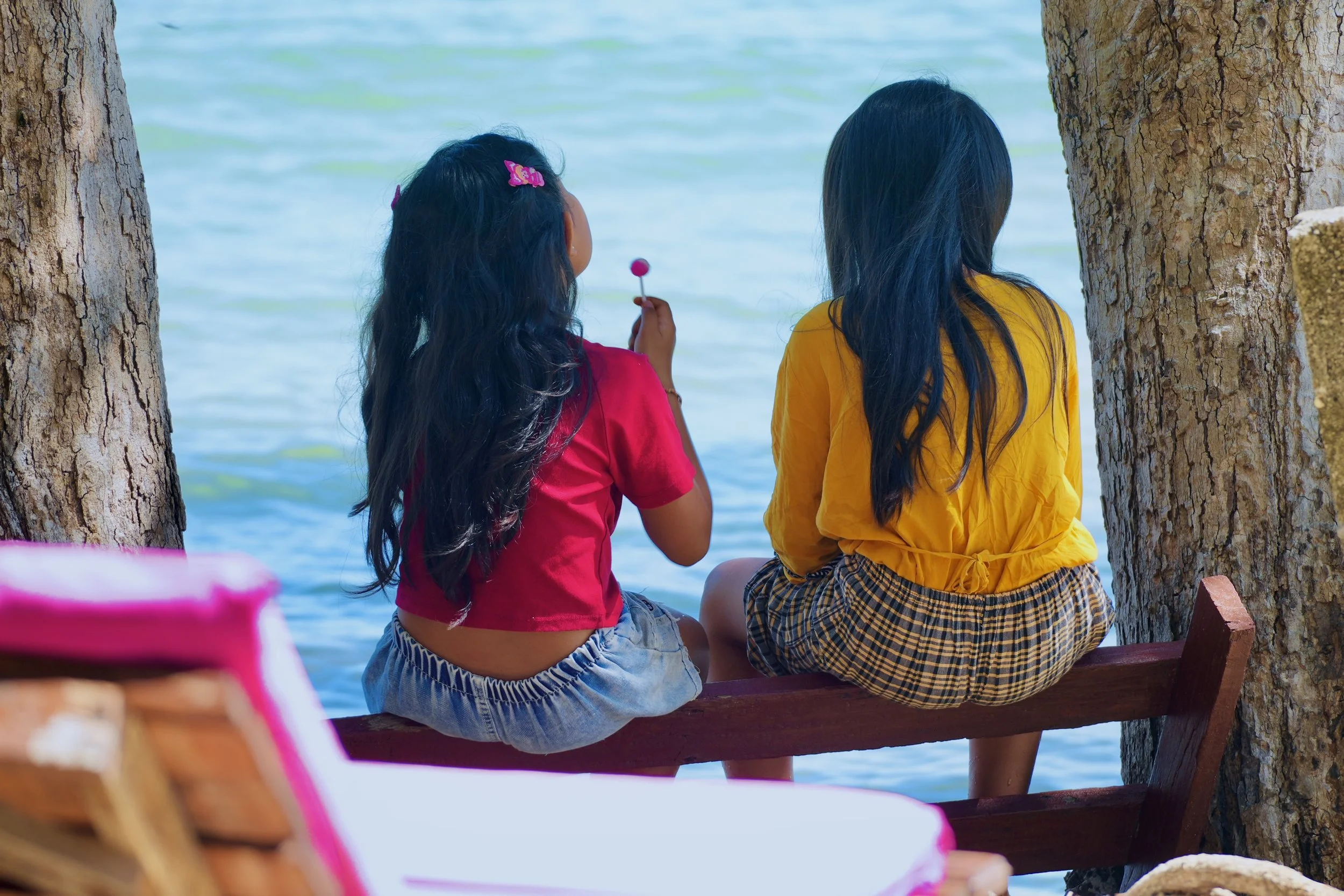
Two girls at the water's edge, backs to the camera. The sea is where the children here have always looked.
Koh Phayam's population is a layered thing. The Moken were here first. Then came the Thai fishermen and farmers who settled the main village, built the Buddhist temple, planted the cashew groves. More recently arrived the Burmese workers — recognizable in the village by the thanaka paste worn on their faces, a Burmese tradition of applying a pale yellow cosmetic paste ground from wood, which softens the skin and marks the wearer's cultural origin as clearly as any passport. On an island thirty kilometers from the Myanmar border, in a region where the fishing industry has long depended on Burmese labor, the presence of this community is unremarkable to anyone who lives here. It is only remarkable to those passing through.
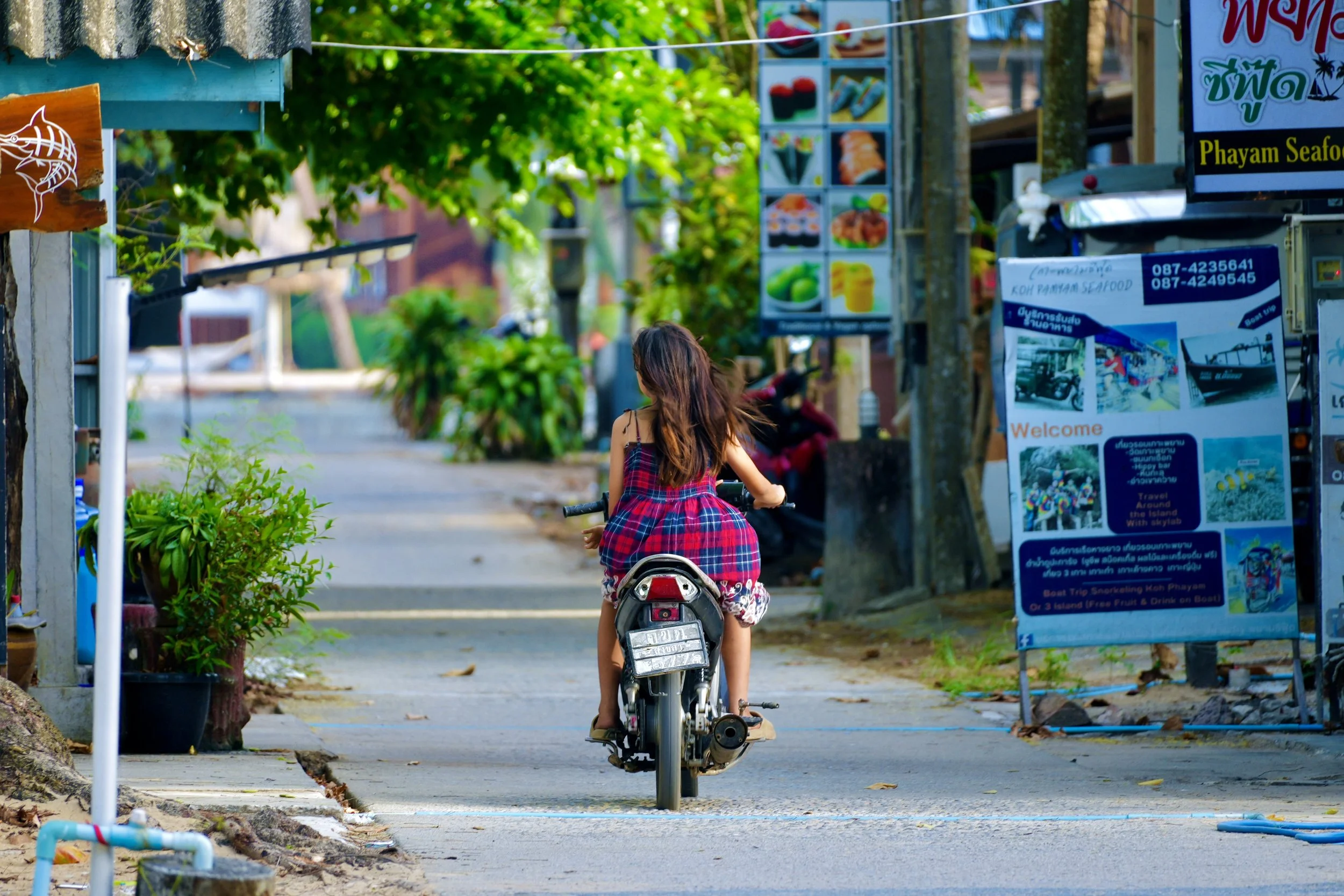
The main street of Koh Phayam village — no cars, motorbikes only, the road barely wide enough for two. This is the island's entire transport infrastructure, and it is exactly the right size.
The main street of Koh Phayam village runs for a few hundred meters between small restaurants, guesthouses, a tour operator's board, a spirit house, a dog asleep in the shade. The only vehicles are motorbikes — there are no cars on the island, no road wide enough to need them. A girl rides past without looking. Behind her the signs for boat trips and seafood and island rentals represent the full extent of the tourism economy here: small-scale, owner-operated, not yet consolidated into anything that would require a consultant.
This is what the island runs on: the ferry's twice-daily delivery of groceries and supplies from the mainland, the fishing boats, the bungalow operations, the cashew harvest, and the particular kind of visitor who doesn't need much and stays long. It is a fragile equilibrium — every island in the Andaman has reached a tipping point at some moment in its recent history — but for now, Koh Phayam remains on the right side of it.
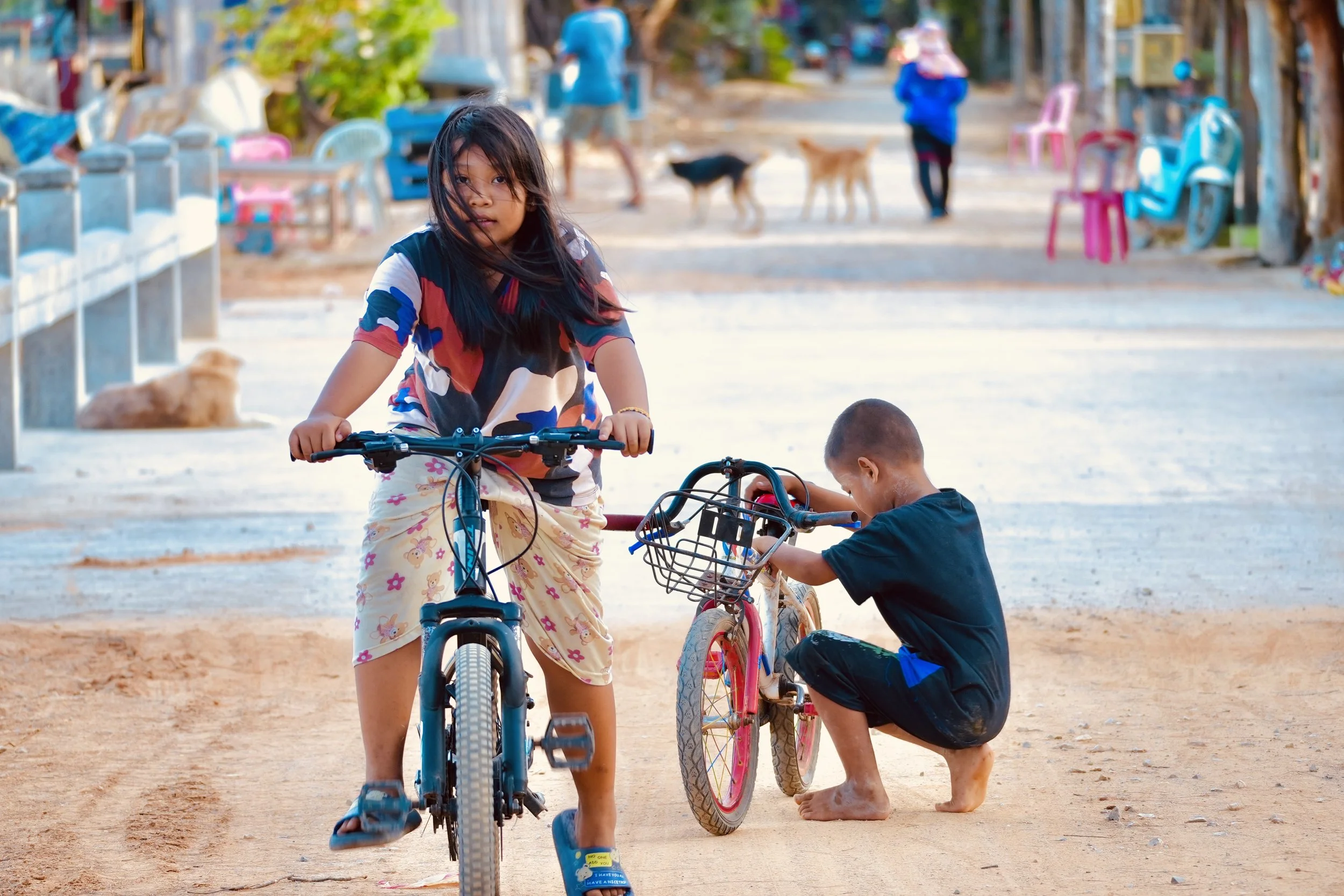
Children on bicycles in the village. On an island with no cars, the bicycle is not a lifestyle choice. It is just how you get around.
The children on Koh Phayam grow up with the sea as a fact rather than a feature. They learn to swim in the same water the fishermen work. They ride bicycles on roads that dissolve into sand at their edges. They attend school in a building that the monsoon floods for several months of the year, alongside classmates whose families have been on this island for generations and others who arrived from Myanmar not long ago and others still whose great-grandparents navigated the Andaman by stars. An island this small, with a population this mixed, produces a particular kind of ordinary life that is invisible to the kind of tourism that photographs sunsets and misses everything else.
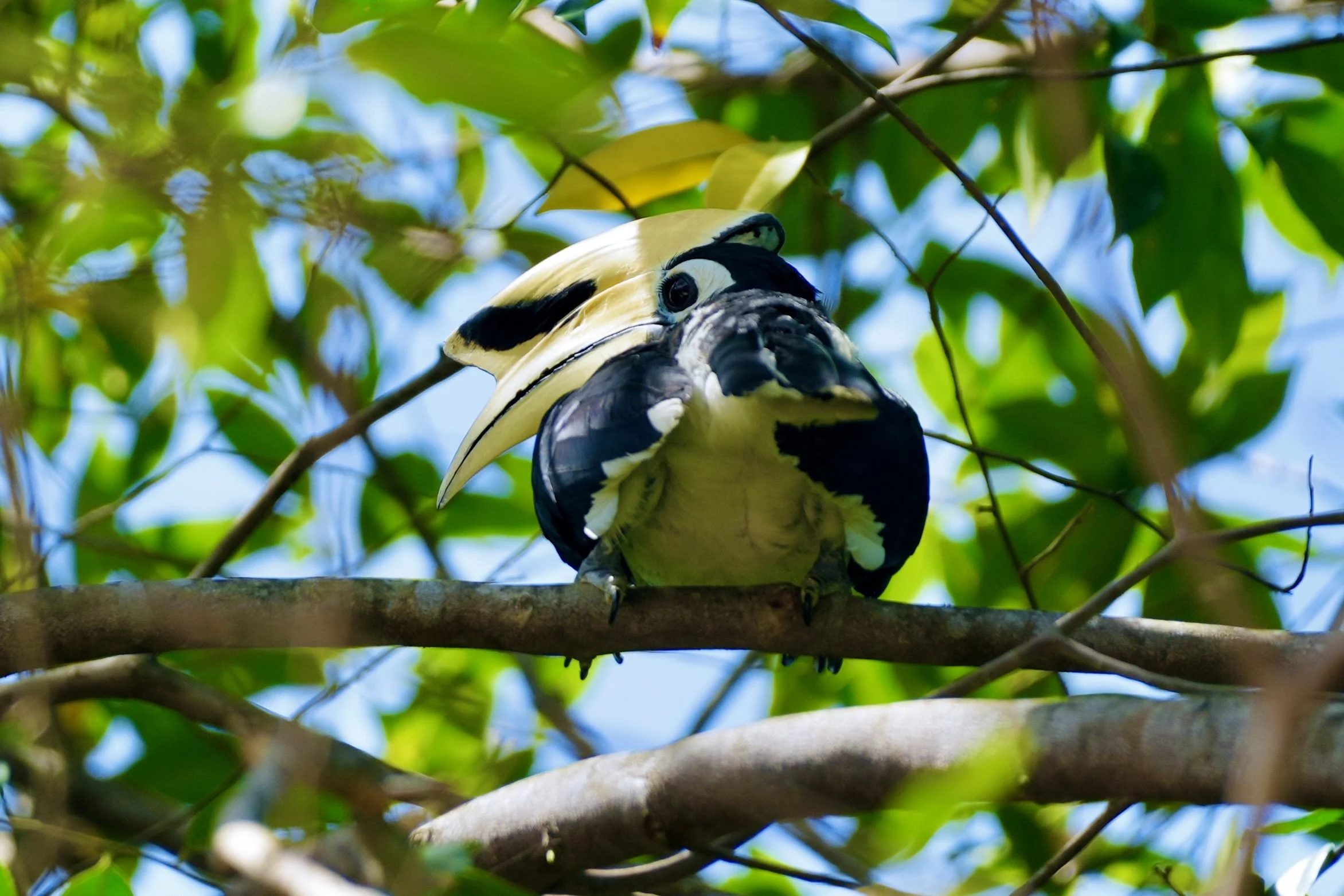
An Oriental Pied Hornbill in the forest canopy. The bird is here because the trees are old enough and tall enough to contain the cavities it nests in. It is an indicator, in both directions.
The Oriental Pied Hornbill was here long before the fishermen, the Moken, the Buddhist shrines, and the backpackers. The island's intact forest canopy is one of the last reliable habitats for this bird along the Thai Andaman coast. Development that has stripped the vegetation from Phuket and Krabi has not yet reached here, which means the trees are tall enough and old enough to contain the cavities that hornbills nest in. They are enormous birds, prehistoric-looking, moving through the canopy with a heaviness that seems unlikely until you see how precisely they land. Their presence on Koh Phayam is an indicator species argument made visible: the hornbill is here because the forest is intact, and the forest is intact because the island hasn't been fully developed, and the island hasn't been fully developed because it is difficult to reach and easy to overlook.
The question that every undeveloped island eventually faces — how to remain what it is — has not yet been answered here. Koh Phayam is still in the process of deciding. The ferry arrives twice a day with its groceries and its visitors. The fishing boats go out before dawn. The mangroves continue their quiet, essential work along the shoreline. The hornbills move through the canopy above all of it, indifferent to the outcome, present only because the conditions for their presence have, so far, been maintained.
To see more photos & videos from my travels visit the links below
happy traveling,
~Sean
