Ubon Ratchathani: Eating at the Edge
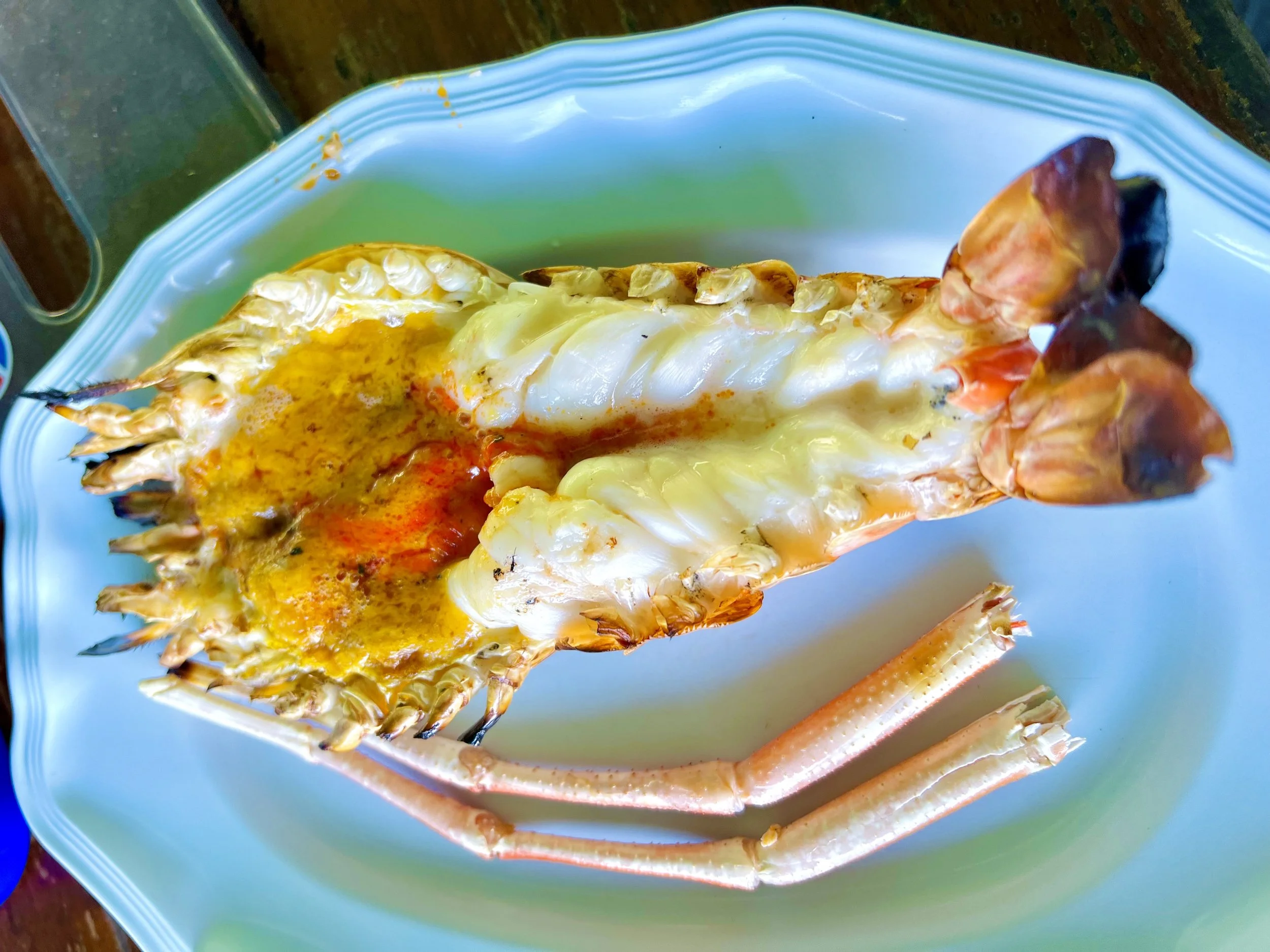
A giant freshwater prawn from the Mun River, split and grilled. In Ubon, the river doesn't just shape the city — it feeds it
Isan food arrived in Bangkok long before most people from the capital ever visited the northeast. The som tam carts, the grilled chicken stalls, the sound of a mortar and pestle working at the roadside before sunrise — all of it traveled south with the millions of Isan workers who moved to the capital over decades, carrying their cuisine like a second language. Isan accounts for roughly 34 percent of Thailand's total population, and its food is now visible on almost every street in Bangkok. But eating Isan food in Bangkok is like listening to music through a wall. You can hear the shape of it. Not the full sound.
In Ubon, there is no translation. The food here is the original text.
The logic of Isan cuisine is inseparable from its landscape. Sticky rice — glutinous, steamed, pulled apart with the fingers — accounts for around 60 percent of the region's cultivated land. It is not a side dish. It is the platform on which everything else is built — rolled into small balls, used to scoop, to dip, to carry. Eating with sticky rice requires both hands and a certain patience. It slows you down in exactly the right way.
Isan food has more in common with Lao cuisine than with the cooking of central Thailand — and you feel that lineage most clearly in the flavour profile: savoury, spicy, and tangy, built on simple local ingredients and the deep complexity of fermentation. At the heart of it is pla ra — freshwater fish packed in salt and toasted rice, fermented in sealed jars for months, pungent and irreducible. Archaeological traces of pla ra have been found in pottery along the Mekong, some buried with the dead, dating back three thousand years. It is not merely an ingredient. It is a continuity.
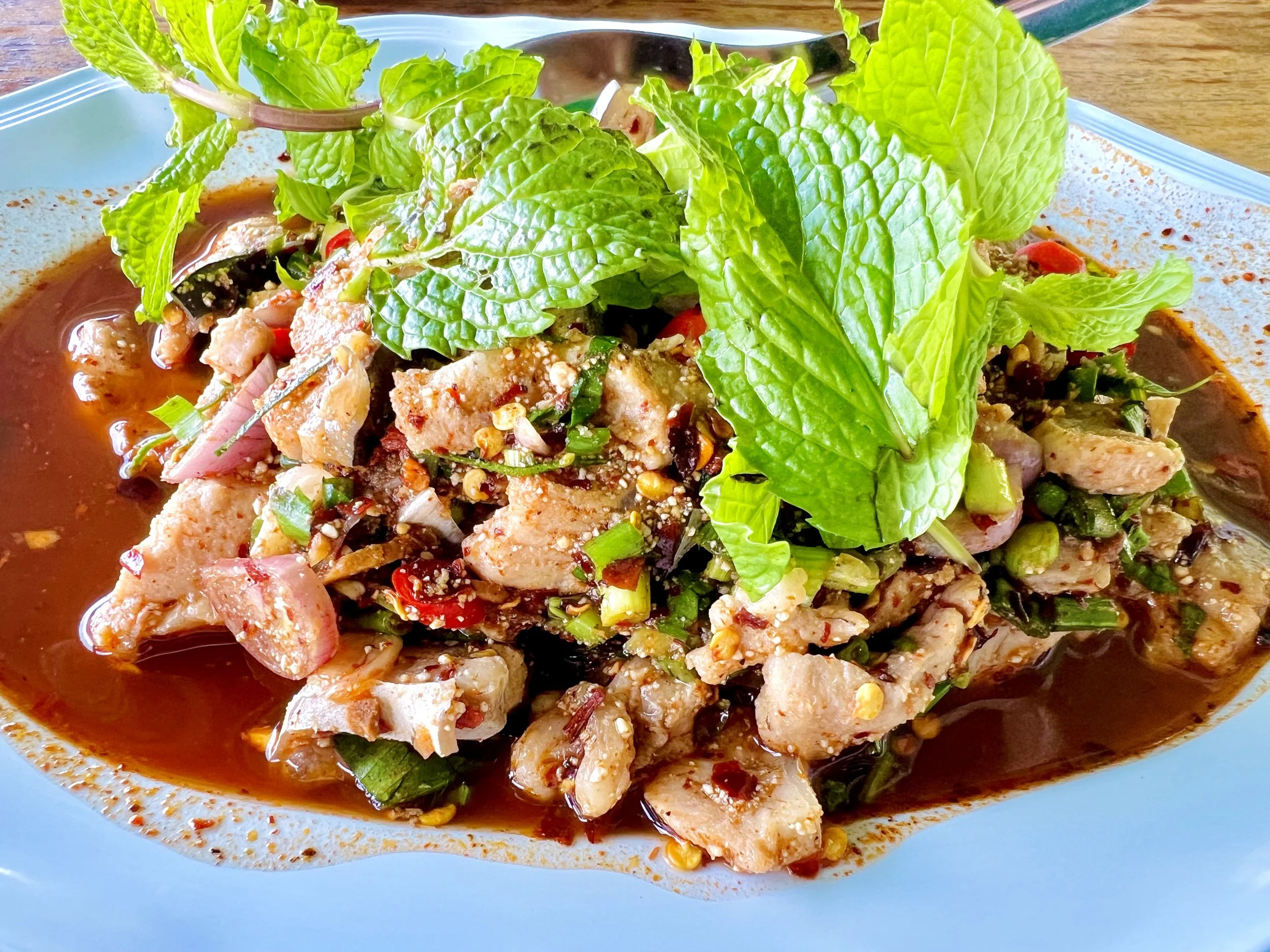
Nam tok — waterfall pork — at a restaurant on the Mun River. Lime, chili, toasted rice powder, and mint. Every element doing exactly what it should
The meal at the riverside restaurant arrived in pieces, each one precise. Nam tok — waterfall pork — named for the juices that run from the meat as it grills: sliced, dressed with lime juice, fish sauce, toasted rice powder, shallots, and a fistful of fresh mint that arrived piled on top like a small green crown. The sourness hit first, then the heat, then something roasted and deep underneath. The stir-fried pork belly alongside it — dry-fried in curry powder until the edges crisped — was its structural opposite: rich where the nam tok was bright, dense where it was sharp. Together they formed a complete argument.
And then the prawns. Giant freshwater prawns pulled from the Mun River, split lengthwise, grilled until the shell charred and the fat in the head turned golden and pooled in the cavity of the body. They arrived at the table still hissing. The heads were the best part — scooped out immediately, eaten before they cooled, tasting of river and fire and something faintly sweet that no sauce needed to improve.
The Mun River runs through Ubon's food the same way it runs through the geography of the city. It provided residents with constant access to water and served as the city's primary transport artery — and it stocked the kitchen. Freshwater fish, river prawns, catfish — the river has been feeding this place for as long as it has existed. Eating a prawn on its banks is not a restaurant experience. It is a continuation.
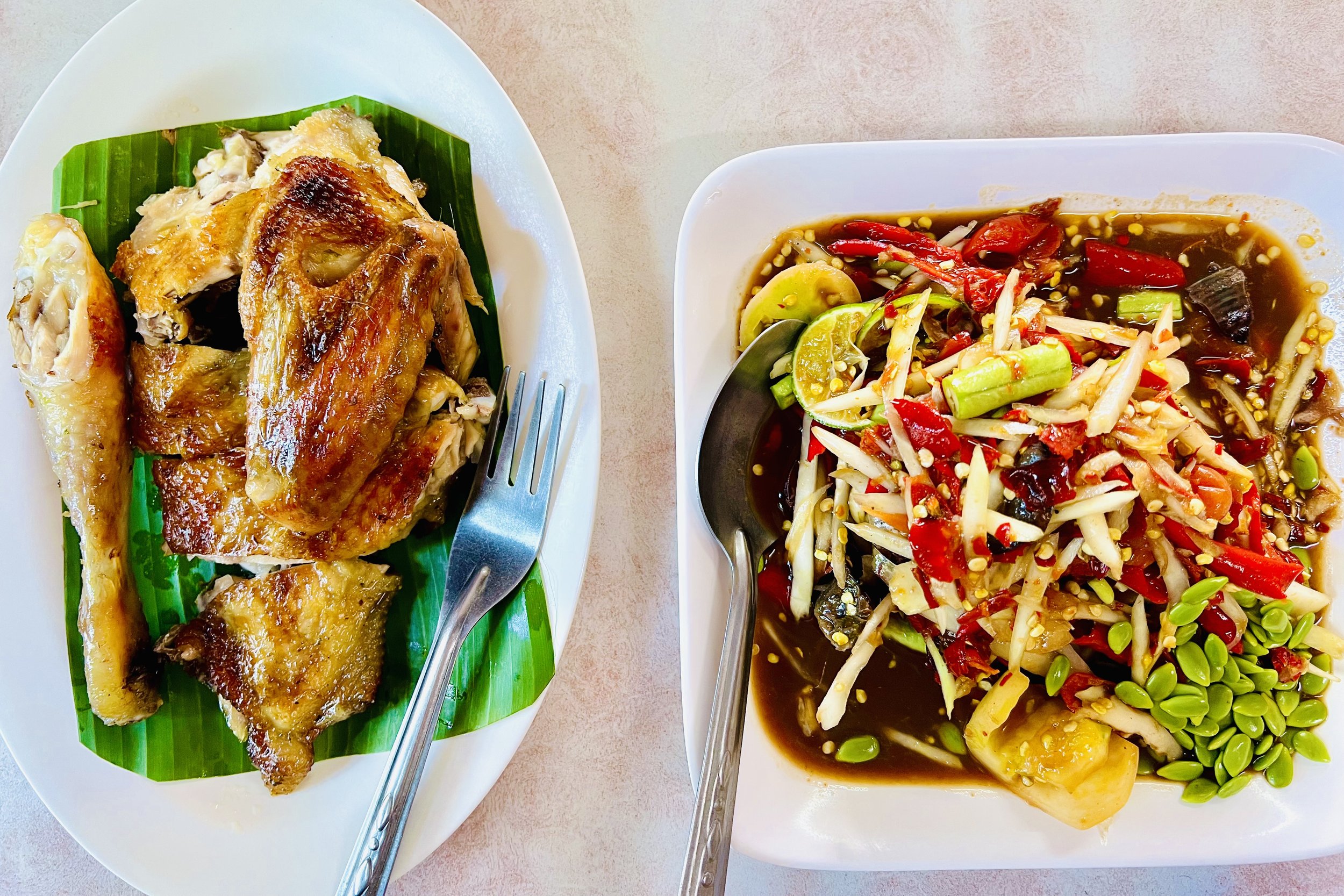
Gai yang and som tam at Santi. The most Isan combination on a table — and one of the most satisfying anywhere
At Santi, the meal was built differently — wider, more deliberate, the kind of spread that requires a large table and no particular plan for the afternoon. Grilled chicken arrived on a bed of banana leaf, butterflied and charcoal-cooked low and slow until the skin lacquered itself into something smoky and giving. Beside it, papaya salad — the Isan version, made with pla ra rather than the sweetened central Thai variant, darker in colour and considerably less forgiving in heat. Sticky rice is pulled into small balls and used to scoop the salad's sauce so the rice and the som tam become a single unit. You don't eat them separately. You eat them as a system.
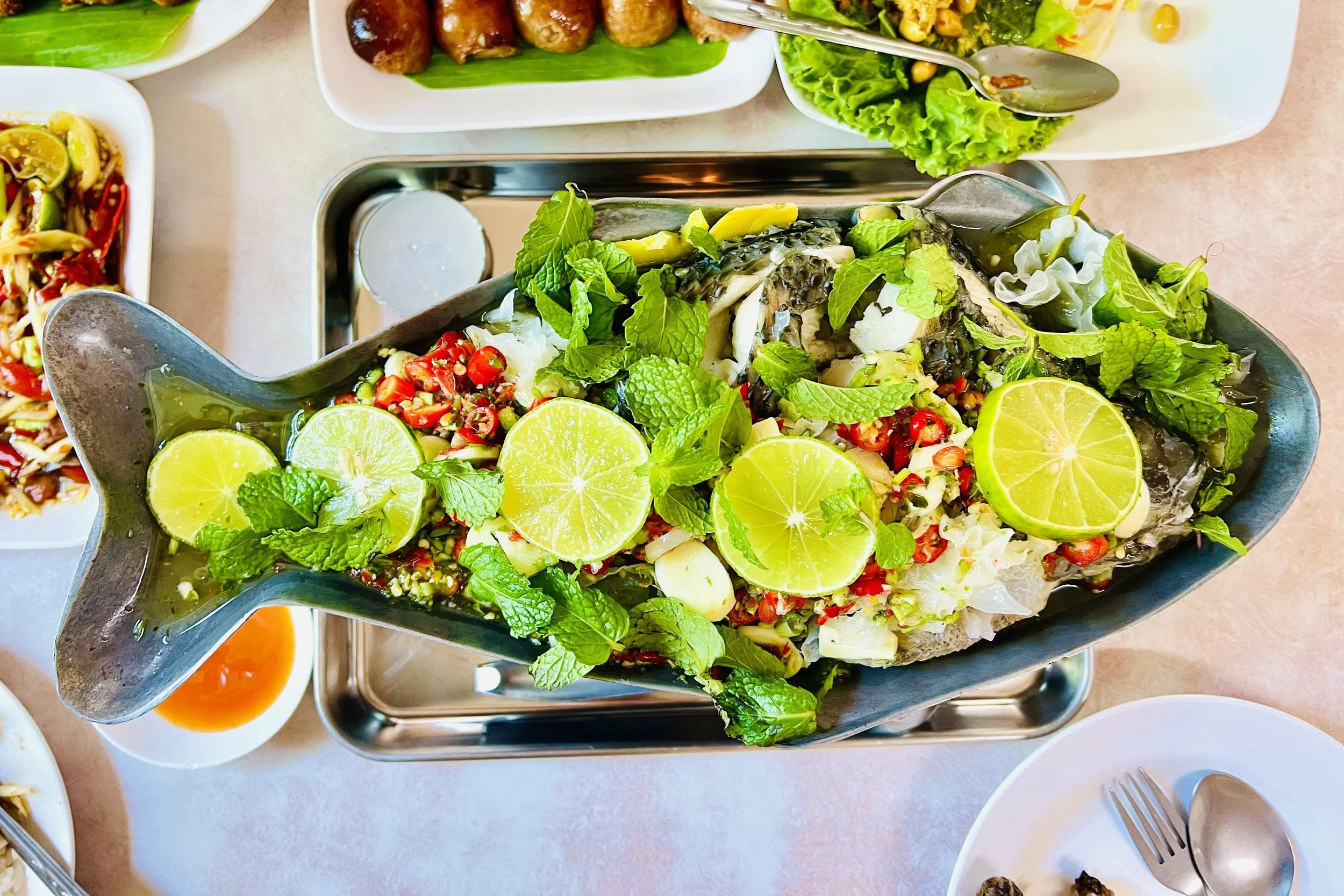
Steamed fish with lime, chili, garlic, and mint, served in a fish-shaped tray at Santi. Brightness and heat in exact proportion
The steamed fish came in a fish-shaped steel tray — a detail that is practical but also quietly perfect, as though the dish is announcing exactly what it is. Whole fish beneath a blanket of sliced lime, minced chili, garlic, and fresh herbs, the flesh just past translucent, the broth collecting in the tray sharp enough to make the eyes water. It was the cleanest thing on the table. Clean in the way that requires enormous precision to achieve.
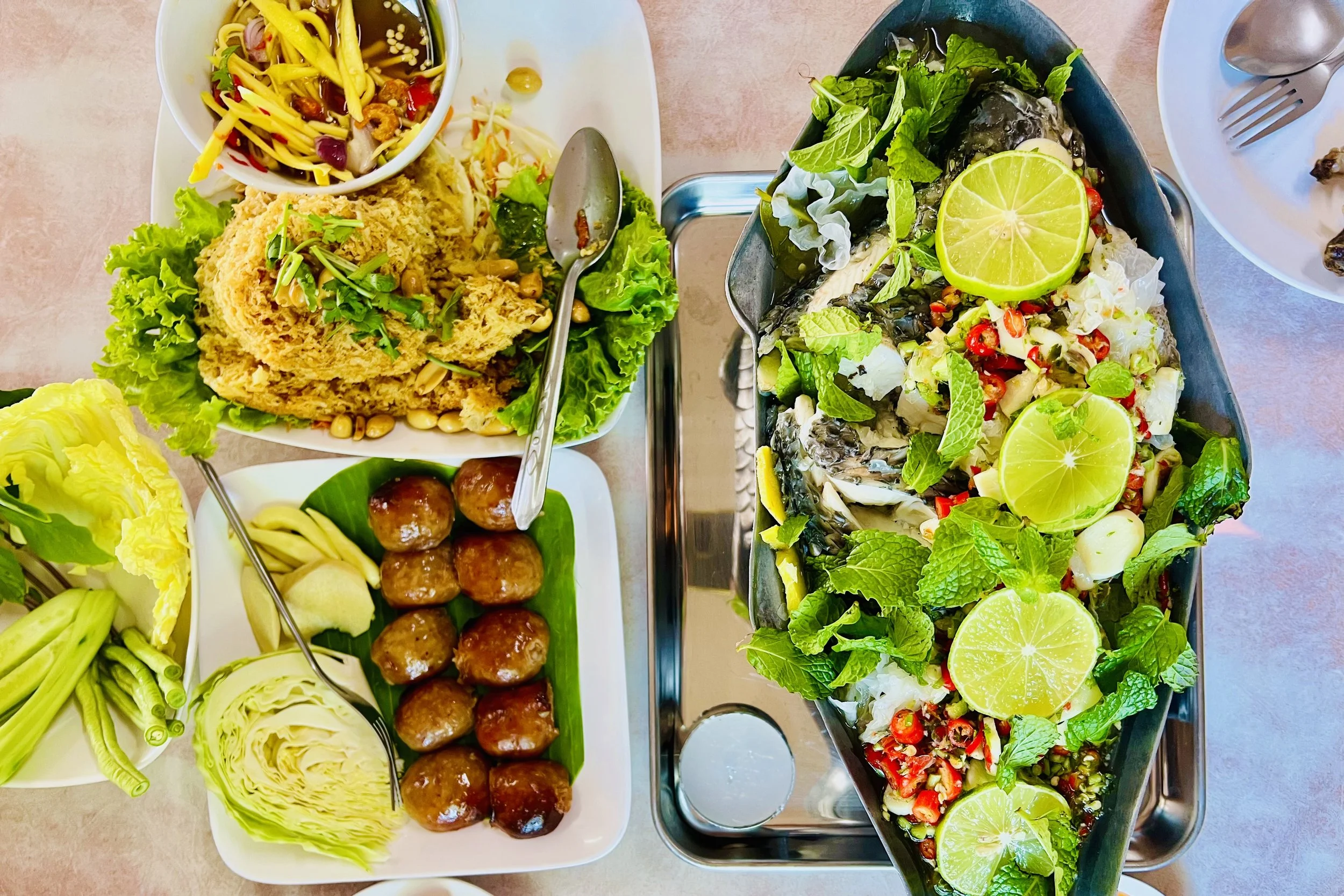
The full table at Santi: steamed fish, crispy catfish salad, northeastern sausage, and more. Isan food is not designed to be eaten alone
Isan people gather around a shared table and serve a variety of dishes alongside sticky rice, meant for the whole group. The meal at Santi demonstrated this completely. Crispy catfish — deep-fried until it shredded into golden threads, dressed with mango salad — sat alongside sai krok Isan: northeastern sausage, fermented and slightly sour, with a snap to the casing and something herbal and complex beneath it. No dish was trying to dominate. Each one was in conversation with the others.
Isan food has spent decades being softened for export — the heat reduced, the fermentation dialed back, the edges smoothed for a palate unfamiliar with the originals. What you eat in Ubon is the unedited version. It does not ask permission.
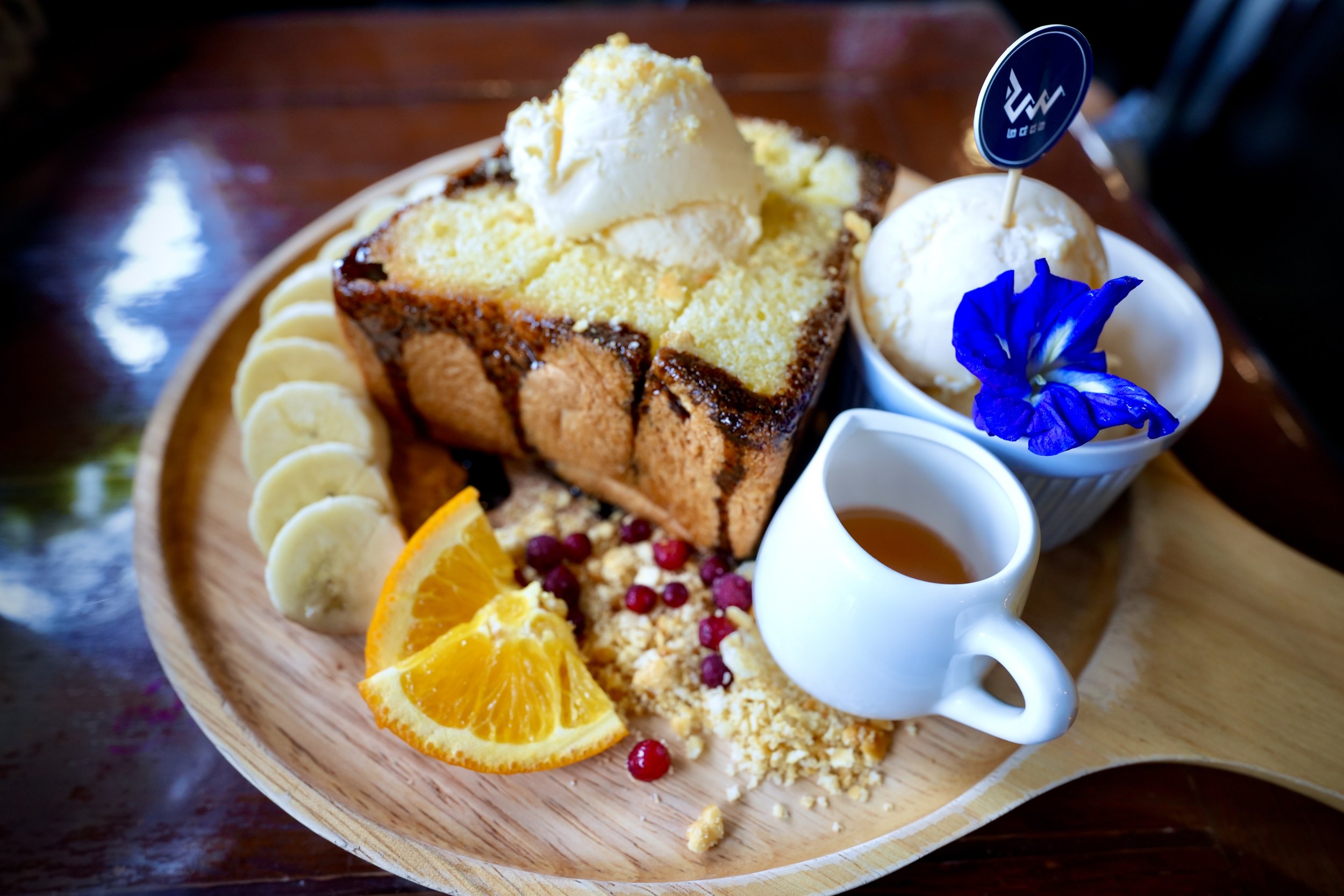
Honey toast and ice cream at Vela Bar Cafe. Even a city serious about its food knows when to stop taking itself seriously
Not every meal in Ubon is a lesson in culinary history. At Vela Bar Cafe, honey toast arrived on a wooden board — thick-cut, caramelised, loaded with ice cream, fresh fruit, and a small pitcher of syrup, a butterfly pea flower tucked into the bowl beside it like a footnote. It was unambiguously, cheerfully a dessert. The cafe was full of young people, ceiling fans turning slowly overhead, the afternoon light coming in low through the windows.
Ubon is a city with deep food roots and an equally intact sense of pleasure. Numbers can sketch the outline — the centuries of fermentation, the rice paddies that cover the plateau, the Lao culinary inheritance that runs beneath everything. But numbers don't explain the specific satisfaction of eating river prawns beside the Mun at dusk, or the way a plate of nam tok reorganises your understanding of what sour means. That part isn't measured. It's eaten.
To see more photos & videos from my travels visit the links below
happy traveling,
~Sean
