Ubon Ratchathani: What the Walls Say
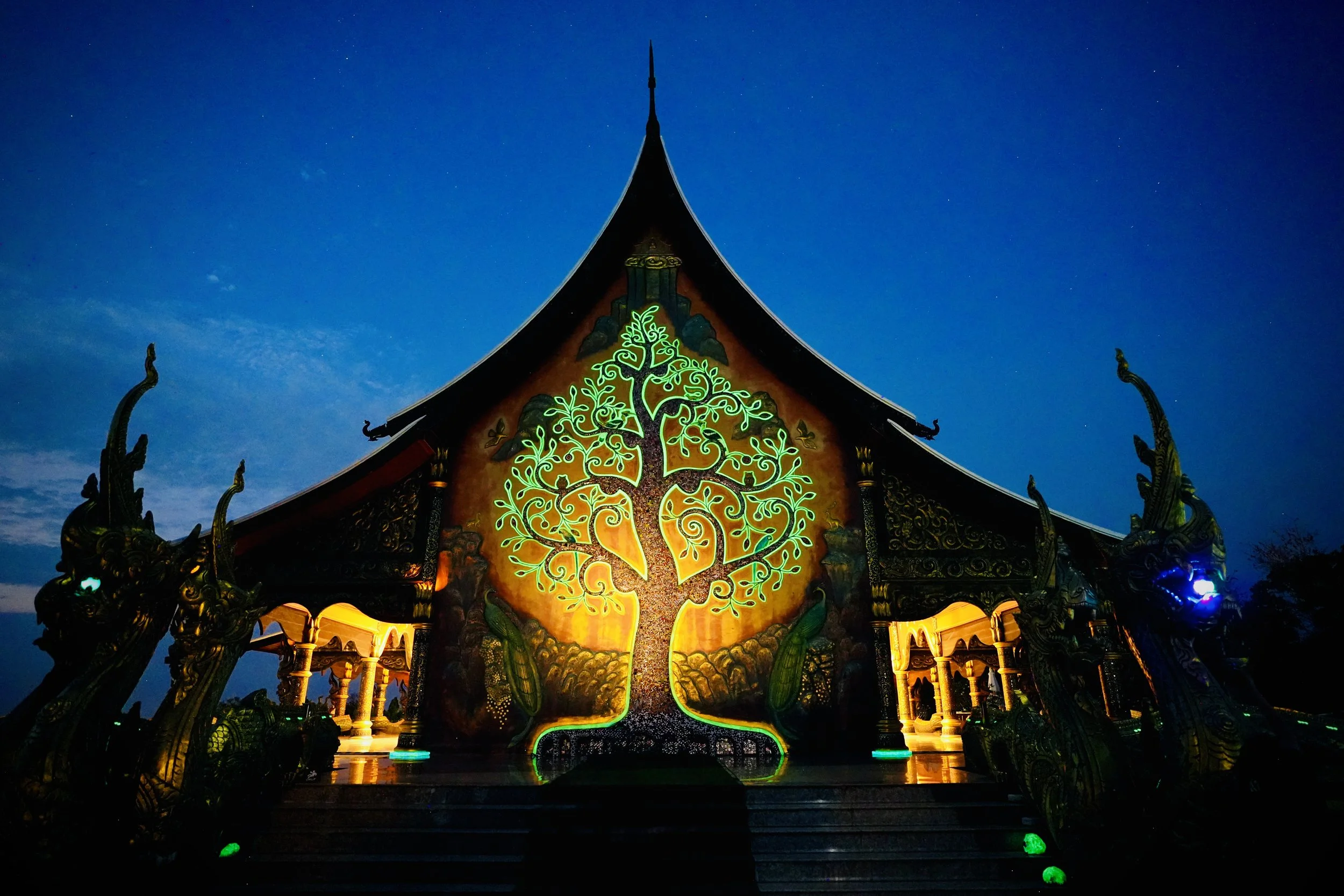
Wat Sirindhorn Wararam Phu Phrao at night. A glowing bodhi tree painted in phosphorescent pigment on a black temple facade, somewhere east of Ubon Ratchathani. This is what contemporary Buddhist architecture looks like when it stops following the rules.
A city's architecture is its autobiography — written slowly, in layers, each generation adding its own chapter to the walls and rooflines left by those before. Ubon Ratchathani is a city of many authors. Lao settlers founded it in the late 18th century, carrying with them the architectural traditions of Vientiane and the Lan Xang kingdom. Bangkok later exerted its influence through administrative reform and the slow imposition of central Thai building styles. Colonial bureaucracy arrived in the early 20th century and left its mark in brick and wide verandas. And through it all, the temples kept being built — each one a negotiation between tradition and ambition, between inherited form and the particular vision of whoever was commissioning the structure.
Reading Ubon's architecture is reading the city's politics, its devotion, and its distance from the capital all at once.
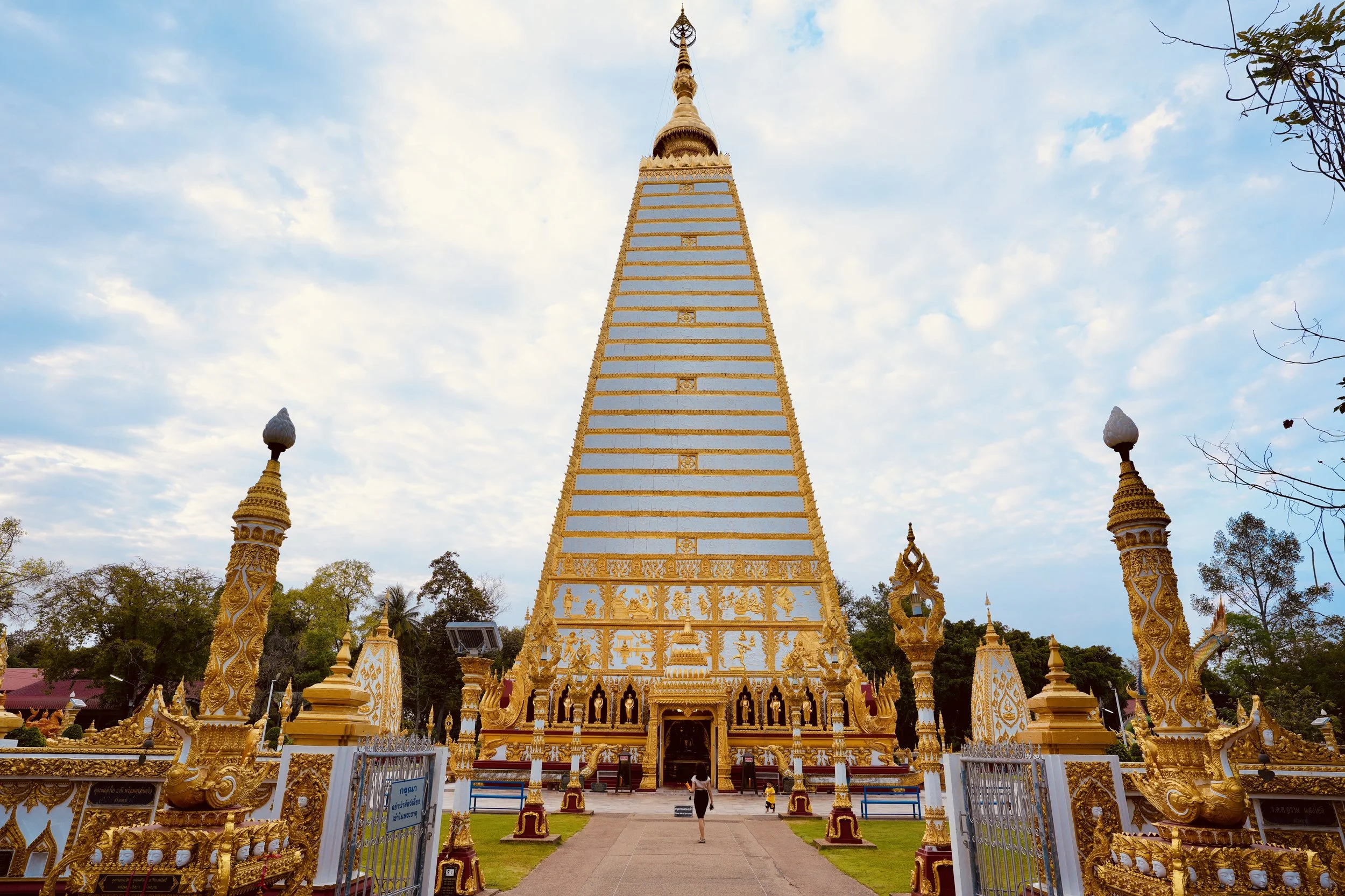
Wat Phra That Nong Bua, Ubon Ratchathani. The chedi is modeled on the Mahabodhi Temple in Bodh Gaya, India — the site of the Buddha's enlightenment. Its presence here, at the edge of the Isan plateau, is a deliberate act of sacred geography.
Wat Phra That Nong Bua is the most architecturally ambitious statement in the city. The chedi — white and gold, stepped and tapering to a fine spire — is modeled on the Mahabodhi Temple in Bodh Gaya, India, the site where the Buddha attained enlightenment beneath a fig tree. To build a replica of this structure in Ubon is to make a claim: that this city, 630 kilometers from Bangkok and deep in the northeast that the capital has long treated as peripheral, belongs to a spiritual geography that extends far beyond Thailand's borders. The Mahabodhi itself dates to the 3rd century BCE. The Ubon chedi was completed in the mid-20th century, but the intention behind it is ancient.
Standing in front of it at dusk, the gold catching the last light before the floodlights take over, you understand something about how Buddhist architecture functions: not as a monument to the past but as a living argument about what matters. The structure is not modest. It is not meant to be.
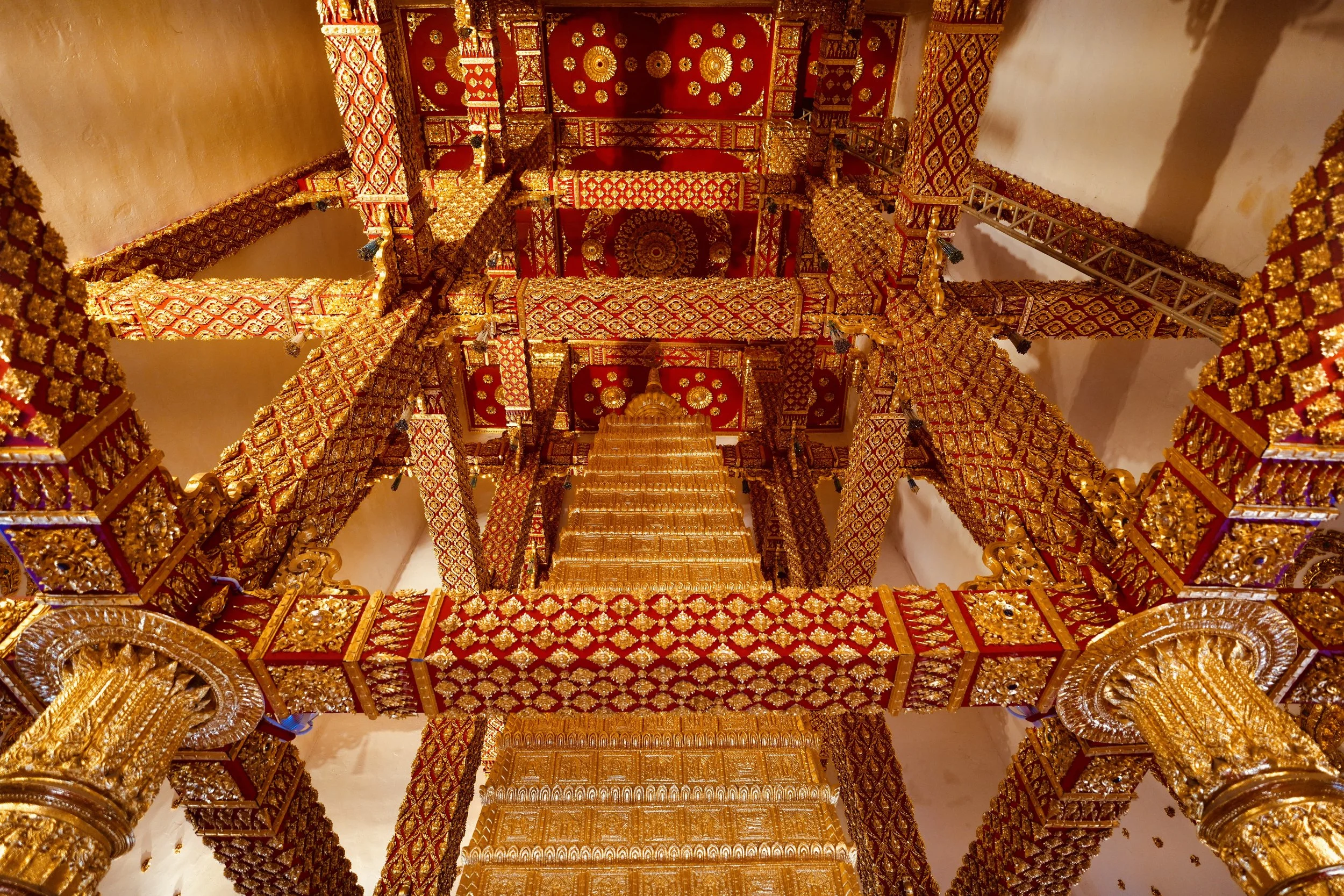
The interior of Wat Phra That Nong Bua — red lacquer and gold leaf covering every surface of the ceiling. Thai and Lao craft traditions, applied with total conviction.
The interior is even more insistent. Every surface of the ceiling is covered in red lacquer and gold leaf — intricate geometric patterns pressing against each other without pause, without rest, without a single centimeter of undecorated space. It is the visual equivalent of a sustained note held for as long as the breath allows. The effect is not overwhelming in the way that might be expected. It is clarifying. This is what absolute commitment to an idea looks like when translated into craft.
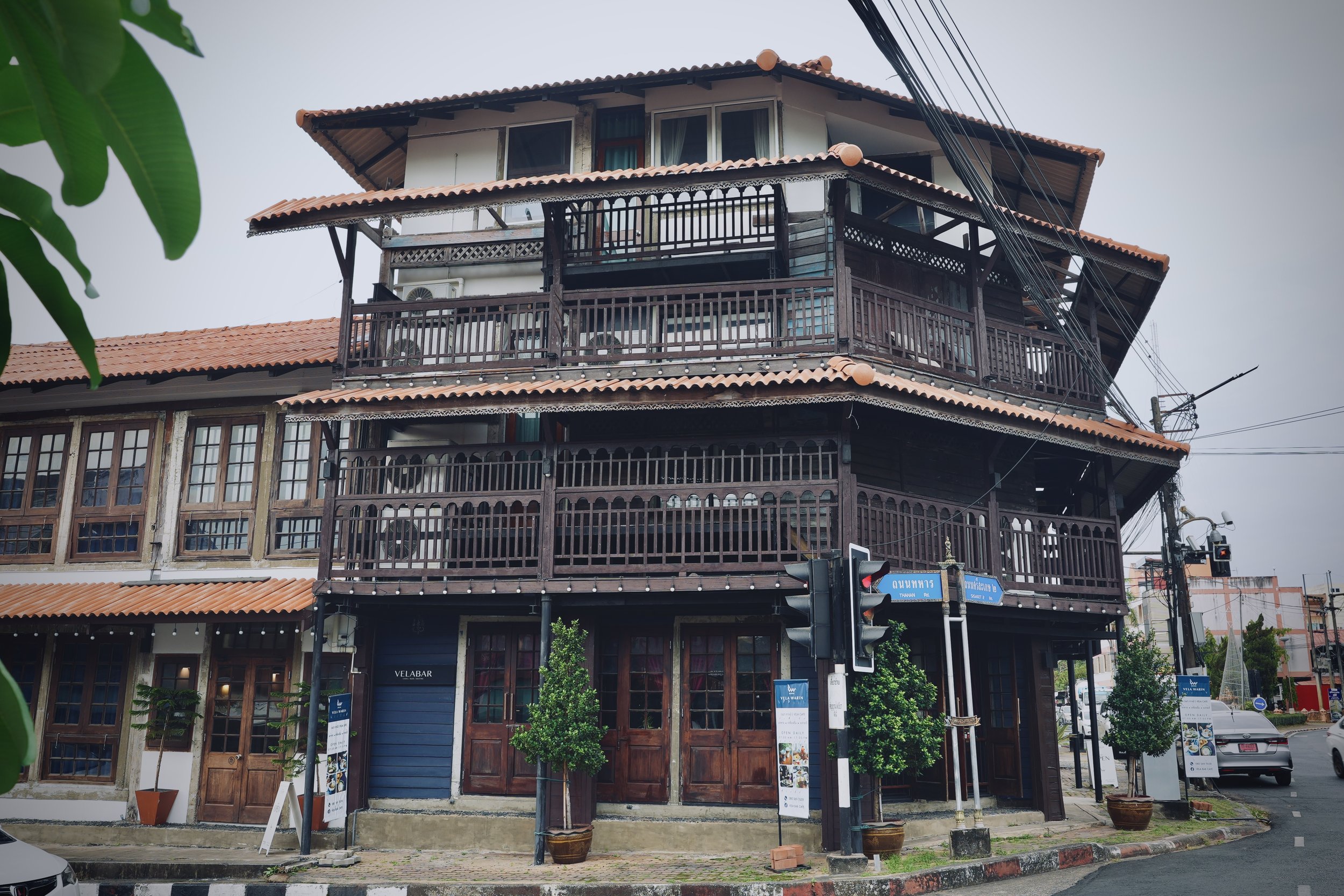
The Vela Bar building on a corner in central Ubon — a three-story wooden structure with wraparound balconies and terracotta roof tiles, built in the early colonial period. Architecture as accidental heritage.
Not all of Ubon's significant buildings are temples. On a corner in the old part of the city stands the Vela Bar building — three stories of dark timber, wraparound balconies, carved wooden railings, and terracotta roof tiles that speak to a completely different architectural moment. This is the colonial-era shophouse at its most developed: the ground floor given to commerce, the upper floors to habitation, the whole structure built to catch whatever breeze the Isan heat allows. The style arrived with administrative reform in the early 20th century — European spatial logic adapted to tropical conditions, a building type that spread across Southeast Asia wherever colonial bureaucracy established itself.
What makes this building interesting is not its style but its survival. Most of Ubon's commercial streets have long since been rebuilt in concrete. The Vela Bar building remains — slightly worn, entirely itself, operating now as a cafe and bar with a traditional mural painting above the bar counter that depicts Isan village life with the casualness of something that has always been there. The building's continued existence is not the result of heritage protection. It is the result of someone choosing not to knock it down.
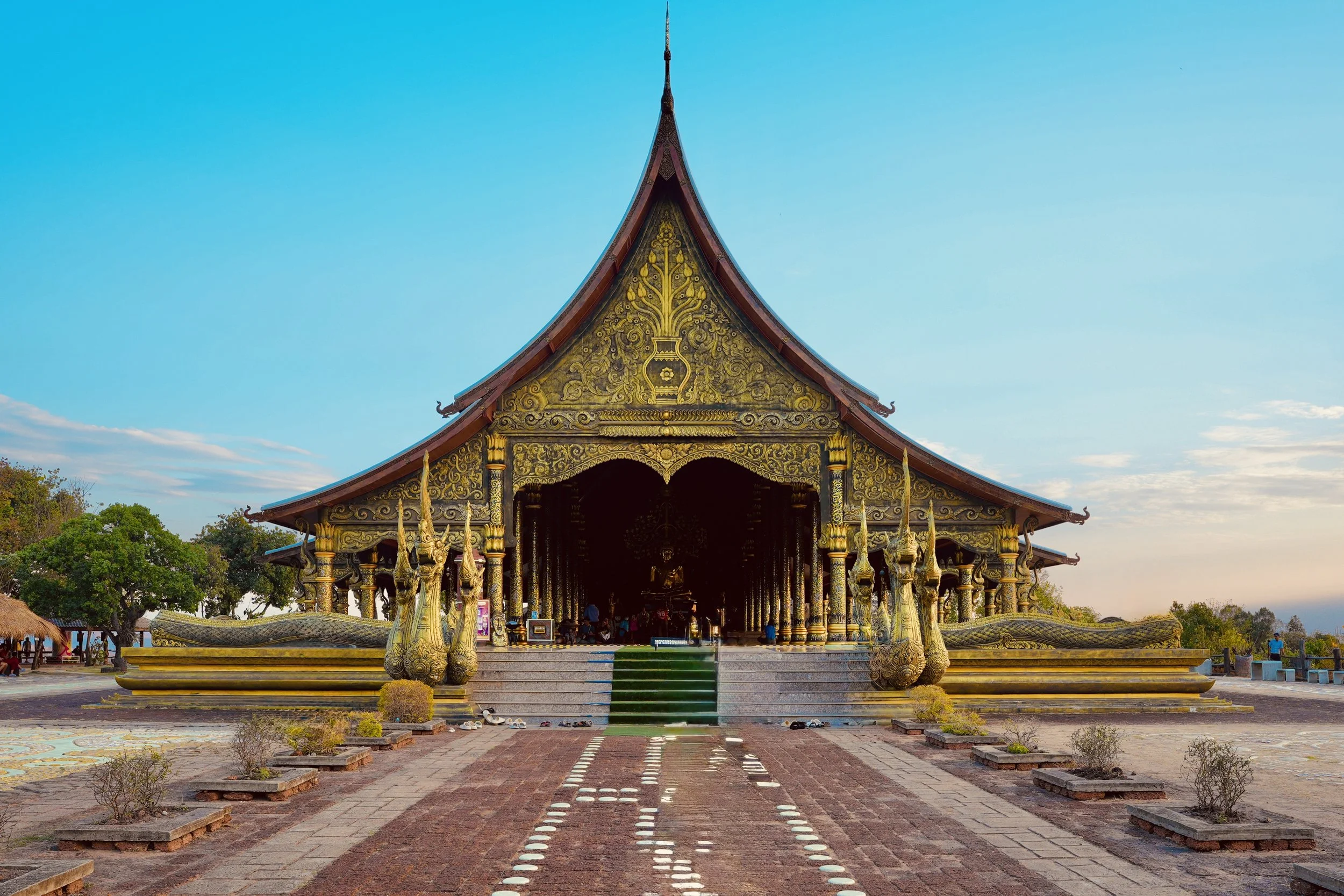
Wat Sirindhorn Wararam Phu Phrao in daylight — a Lan Xang-style roof sweeping low over a golden facade, naga serpents guarding the steps. The roofline alone places this firmly in the Lao architectural tradition.
Wat Sirindhorn Wararam Phu Phrao sits about an hour's drive east of Ubon, on a hill above a reservoir, and by daylight it is already remarkable. The roofline sweeps low and wide in the Lan Xang style — the architectural inheritance of the Lao kingdom that once defined this entire region — its edges curving upward at the tips in a movement that is simultaneously architectural and calligraphic. Gold naga serpents guard the entrance steps, their heads rearing above the threshold. The building is dark timber and gold, restrained by the standards of what waits after dark.
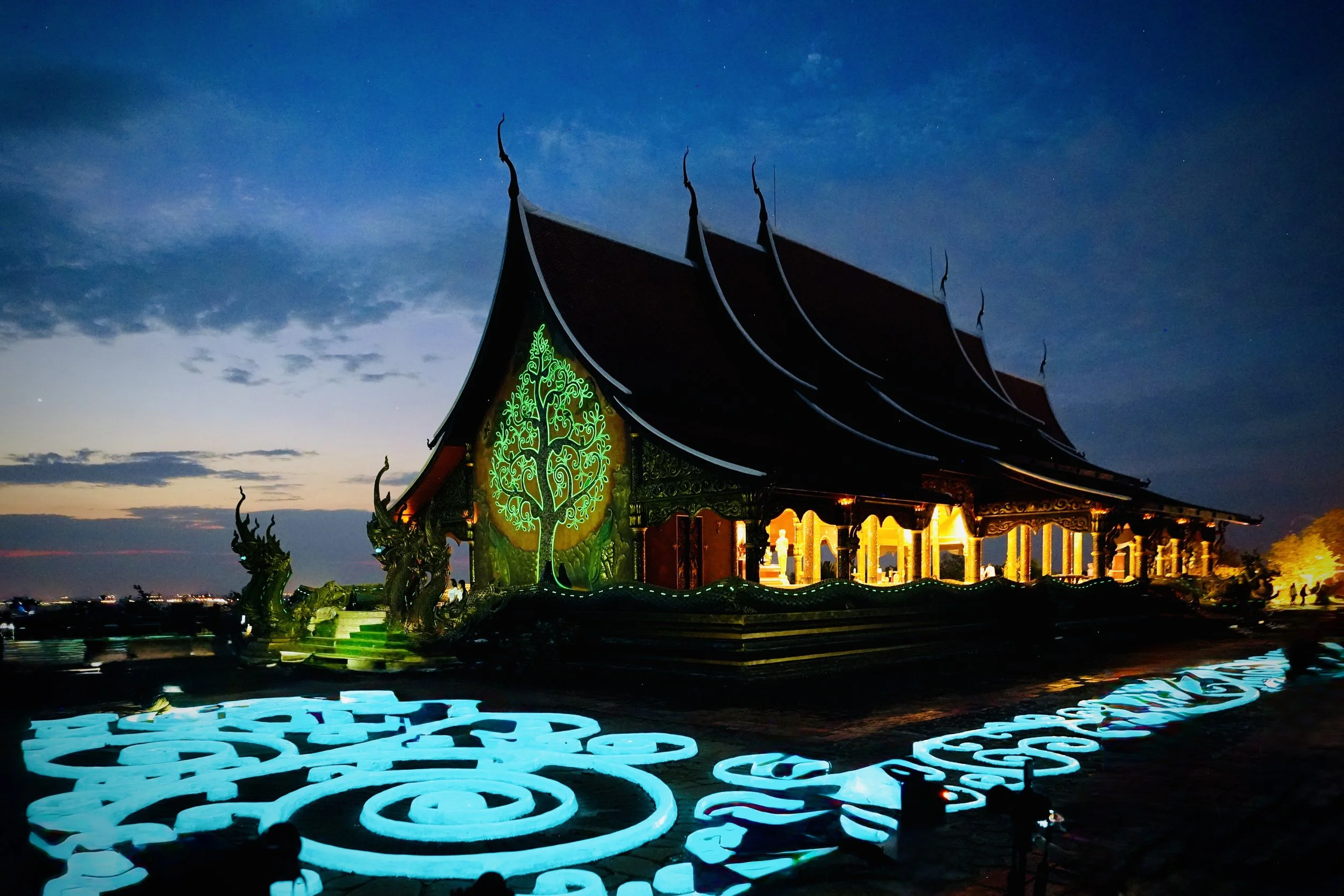
Wat Sirindhorn Wararam Phu Phrao after dark. Phosphorescent paint on the black facade traces a bodhi tree that is invisible in daylight. The glowing ground patterns draw visitors into the space itself. Architecture experienced as a phenomenon.
After dark, the temple transforms completely. The entire facade is painted black — and onto that black surface, in phosphorescent pigment that is invisible in daylight, a bodhi tree has been rendered in extraordinary detail, its branches reaching toward the roofline, its roots anchoring it to the ground. Under ultraviolet light the tree appears to glow from within, green and luminous against the dark, while blue light traces ornamental patterns across the courtyard floor. The effect is genuinely startling — not theatrical in the commercial sense, but devotional in a way that uses contemporary materials to achieve something older: the experience of the sacred as something that cannot quite be explained.
The bodhi tree is the tree under which the Buddha sat when he attained enlightenment. Its appearance here, glowing on a black wall in the dark above a reservoir in eastern Isan, is a piece of theological architecture. The building is designed to be encountered twice — once in daylight and once in darkness — and it is a completely different structure each time.
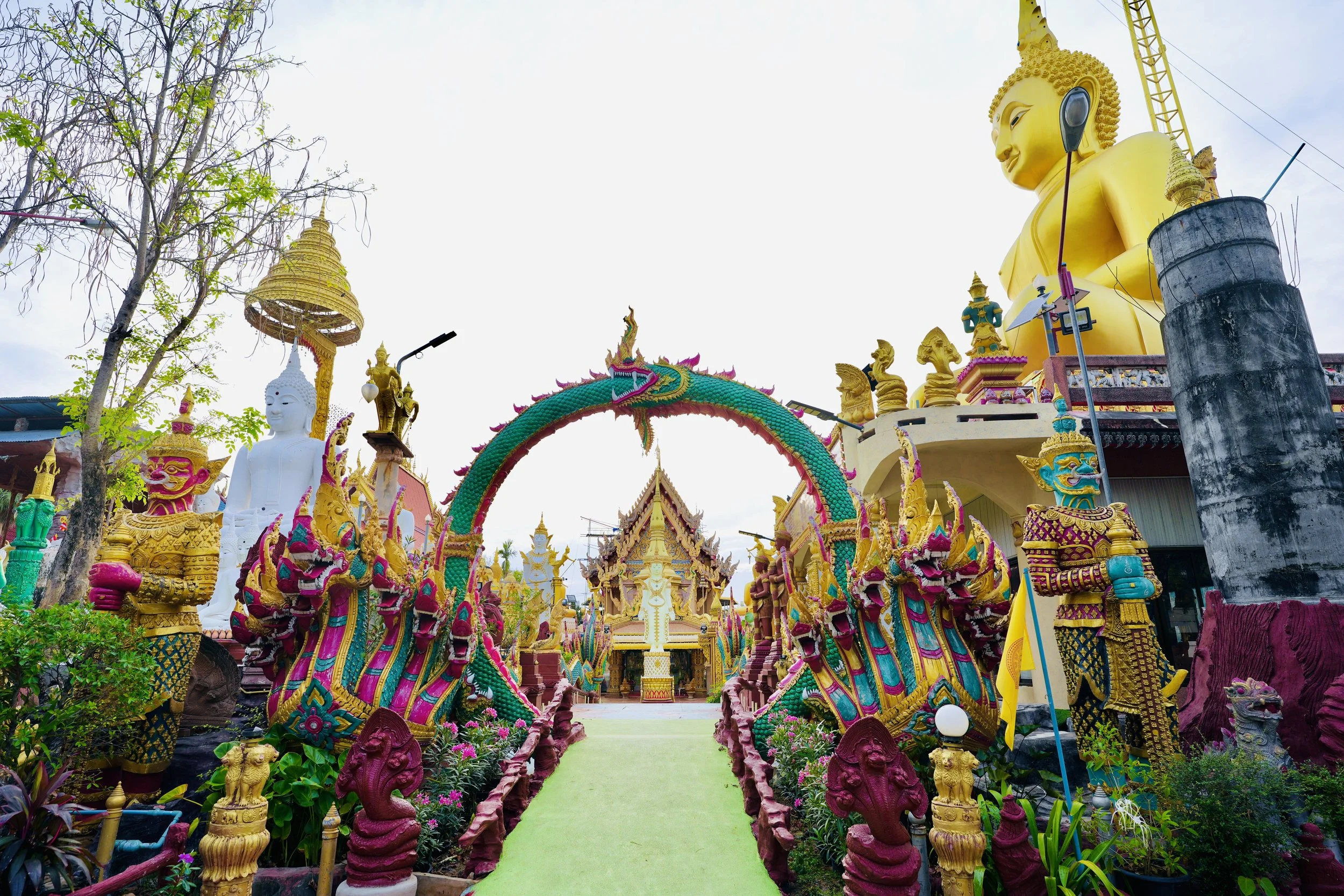
The entrance to Wat Tai Phrachao Yai Ong Tue — a naga arch in magenta, gold and green framing a path toward the main hall. The visual density here is total. Every surface is doing something
If Wat Sirindhorn is architecture as subtlety — a building that reveals itself slowly, in darkness — then Wat Tai Phrachao Yai Ong Tue is its opposite. This temple in the heart of Ubon operates on the principle that more is more, applied with absolute sincerity. A naga arch in magenta, gold, and green marks the entrance. Guardian figures in full polychrome line the path. Beyond them, the compound unfolds into a world of stacked imagery: Buddha statues in gold, silver, and black arranged in rows along rooflines and walls; nagas coiling at every entrance; giant seated Buddhas presiding over the whole complex from above.
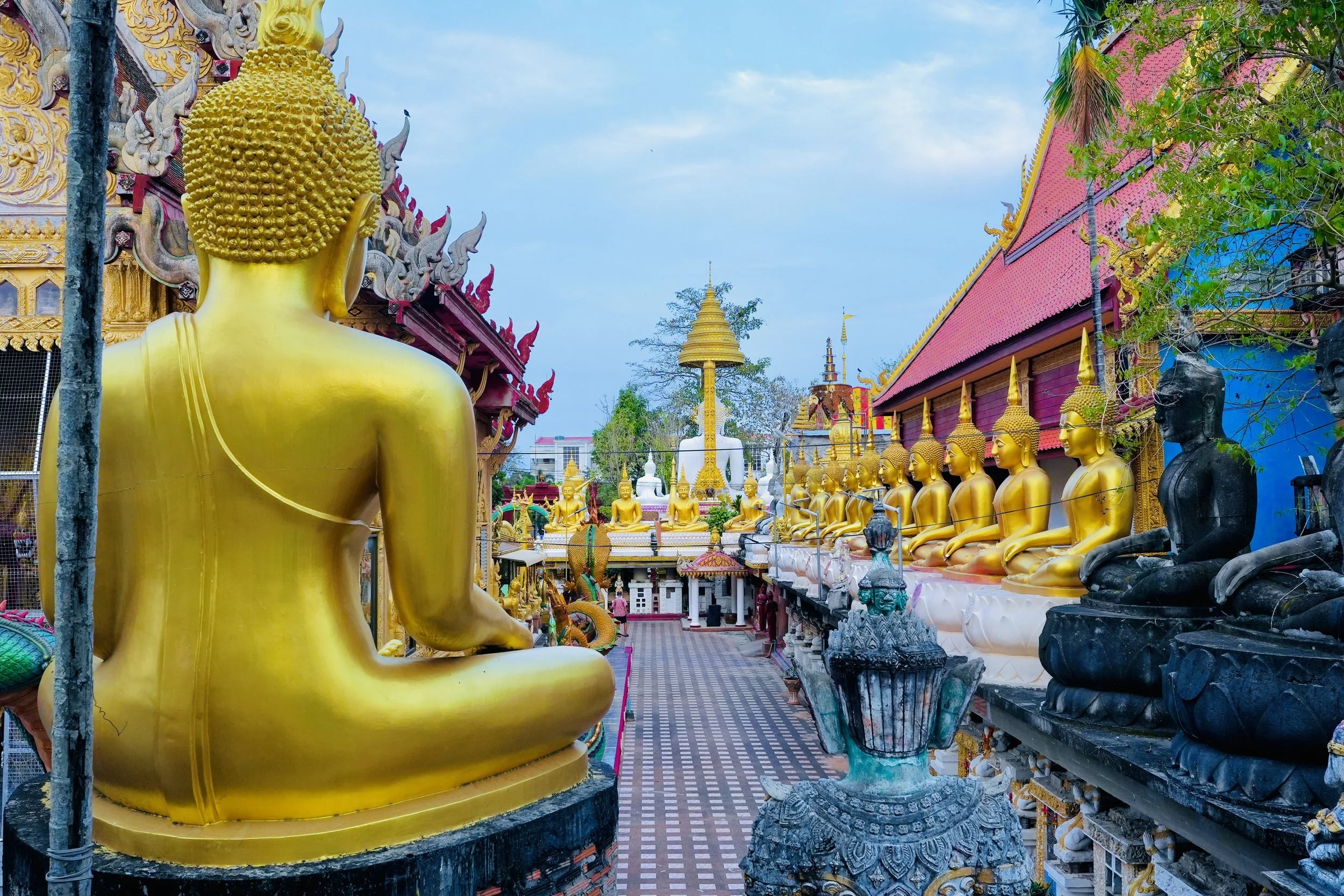
Rows of golden Buddha images at Wat Tai Phrachao Yai Ong Tue. Repetition as devotion. Accumulation as architecture
What Wat Tai Phrachao Yai Ong Tue understands is something the Western architectural tradition tends to resist: that accumulation itself is a form of meaning. Every image added to this complex is an act of merit-making by a donor, a family, a community. The resulting density is not chaos. It is the physical record of collective devotion, built up over decades, each addition a transaction between a worshipper and the sacred that gets added to the wall of the previous one. The architecture is not designed from a plan. It grows from a practice.
Ubon's built environment spans two and a half centuries — from the Lao-influenced temples of its founding to the phosphorescent bodhi tree of Wat Sirindhorn, from colonial timber shophouses to golden chedis modeled on sacred sites in India. What holds it together is not a consistent style but a consistent impulse: to build in ways that make the city's beliefs visible, and to do so without apology for where on the map those beliefs have taken root.
To see more photos & videos from my travels visit the links below
happy traveling,
~Sean
