Ubon Ratchathani: Deeper Than the Road
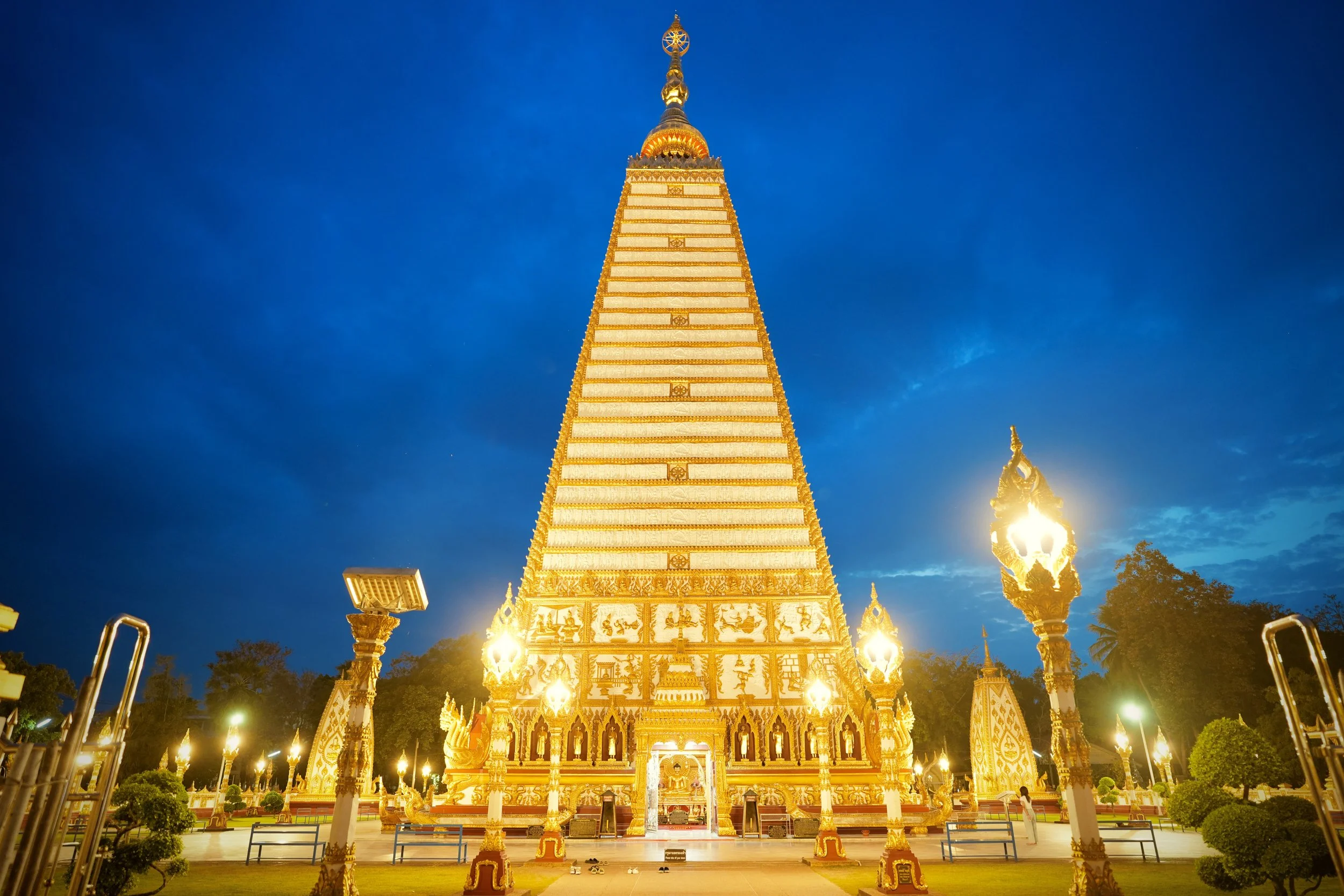
Wat Phra That Nong Bua illuminated after dark. A city that built this, 630 kilometers from the capital, was making a statement about where it stands.
There is a number that follows Ubon Ratchathani everywhere it appears in official statistics: 630. The kilometers between this city and Bangkok. It appears in government reports, in tourism brochures, in academic papers about regional development and economic disparity. It is meant to convey distance. What it actually conveys is the gap — not just geographic but economic, political, and historical — between a city that has always fed and sustained the country and a capital that has rarely returned the favor in kind.
Isan accounts for roughly a third of Thailand's total population and a third of its land area. It produces around 10 percent of the country's GDP. In 2024, the Thai government allocated just 5.54 percent of its national budget to the entire region — while allocating nearly ten times that amount to Bangkok, a city with less than half of Isan's population. In 2020, per capita GDP in Bangkok was more than six times that of the northeast. These are not new numbers. They are the stable arithmetic of a system that has consistently underinvested in its own largest region for decades.
Ubon Ratchathani province is the nation's leading rice producer, earning more than 10 billion baht a year from rice sales alone, with around half its workforce employed in agriculture. The food that lands on tables across Thailand — the sticky rice, the river fish, the fermented ingredients that define the country's most beloved cuisine — comes disproportionately from land like this. Ubon feeds the country. The country pays it back with roads and rail infrastructure that lag behind the central region by a generation.
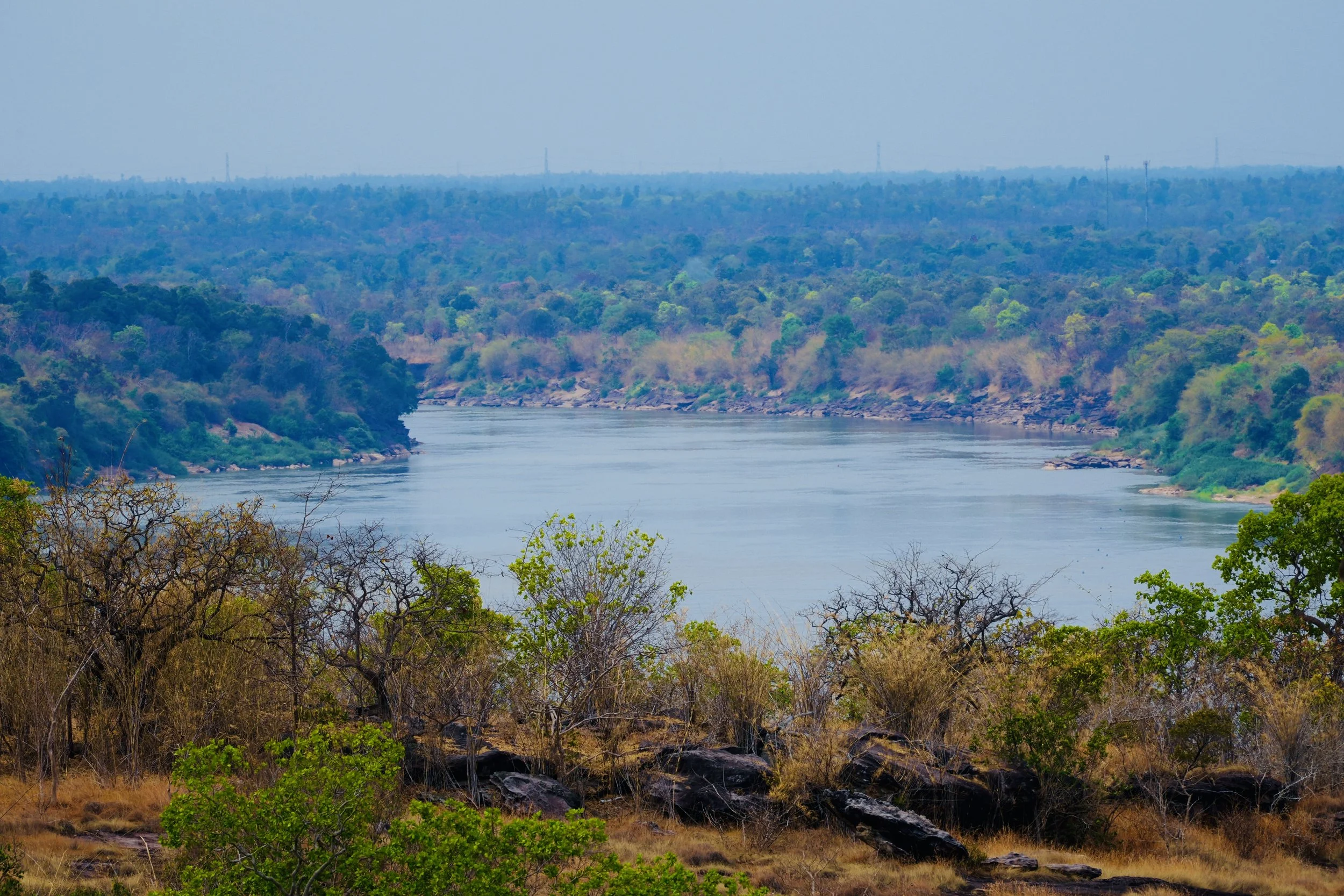
The Mekong River from the cliffs of Pha Taem, looking east into Laos. The border is a line on a map. The landscape belongs to something older and larger than any of the countries it separates.
And yet. Sitting on the sandstone cliff at Pha Taem, looking out across the Mekong toward the forests of Laos, the economic statistics feel like they belong to a different conversation entirely. The prehistoric rock paintings on the cliff face below were made between three and four thousand years ago by people who fished this river and farmed this plateau — people for whom none of the borders or budgets or disparity indices that now define this place existed in any form. More than 300 pictographs in red ochre stretch across 180 meters of cliff wall. They are still legible. The Mekong below them is still running.
What Pha Taem demonstrates — what this entire province demonstrates — is that significance is not the same thing as recognition. A place can matter enormously, can be ancient and ecologically complex and culturally rich and economically productive, without appearing prominently on the maps that power draws of itself. Ubon Ratchathani has been significant for thousands of years. It has been underrecognized for most of the modern period.
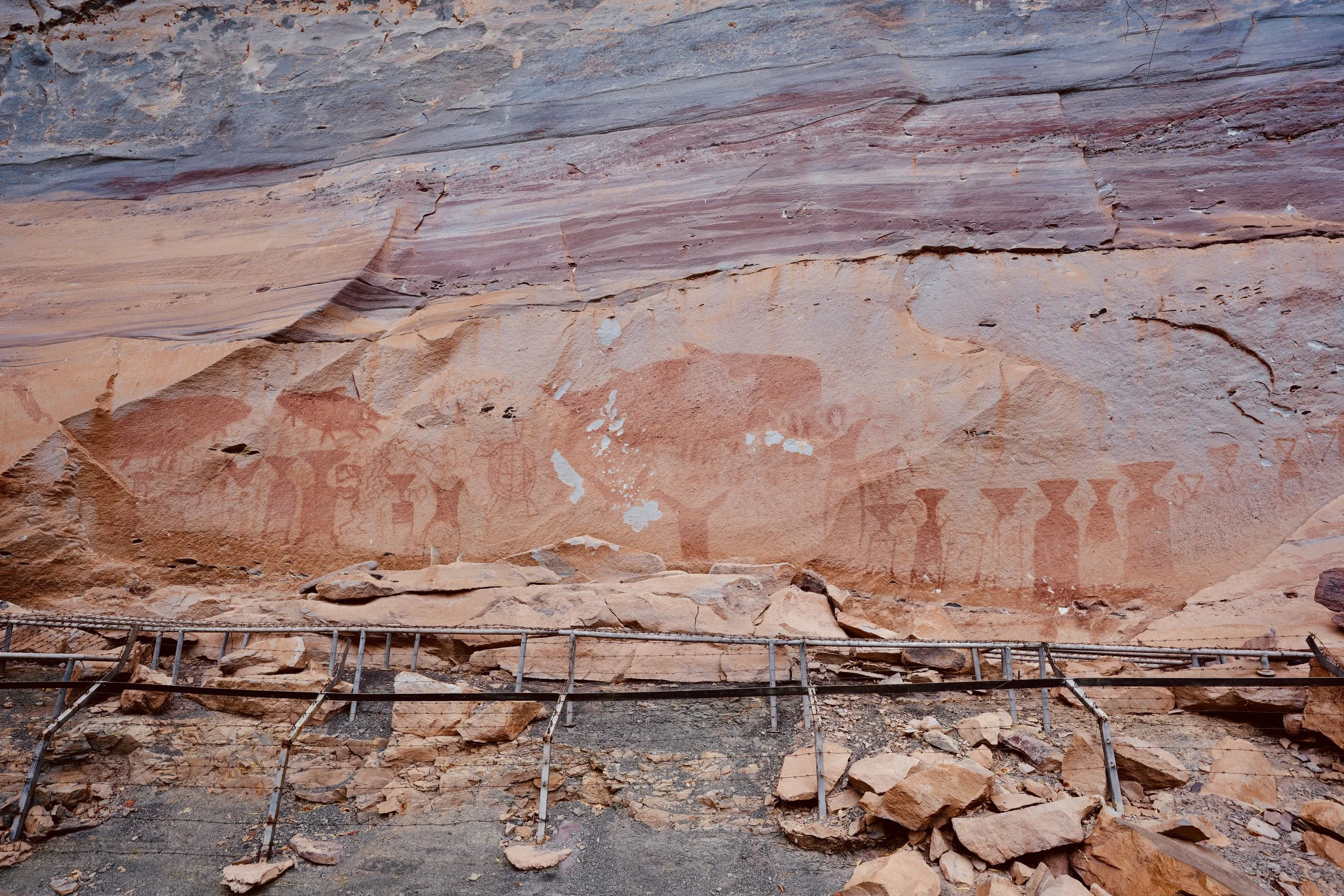
Three thousand years of human record on a sandstone cliff above the Mekong. Fishing, farming, daily life — painted in red ochre by people who understood this place long before it had a name.
The city itself, seen as a system rather than a destination, tells a coherent story. A metro population of around 521,000 — growing at just over one percent annually — occupying a provincial area of 15,744 square kilometers. Its economy organized around agriculture, its urban core around Buddhist institutions whose architecture records two centuries of negotiation between Lao heritage, Bangkok's centralizing ambitions, and the particular vision of whoever happened to be commissioning the next structure. The Mun River dividing the city from its suburb of Warin Chamrap, the two connected by bridges that carry the daily commute of a place that functions, in practice, as a single urban unit split by water.
A city at the administrative edge of a region that has always been treated as peripheral. And within that city — the temples, the food, the river, the land — a fullness that does not feel peripheral at all.
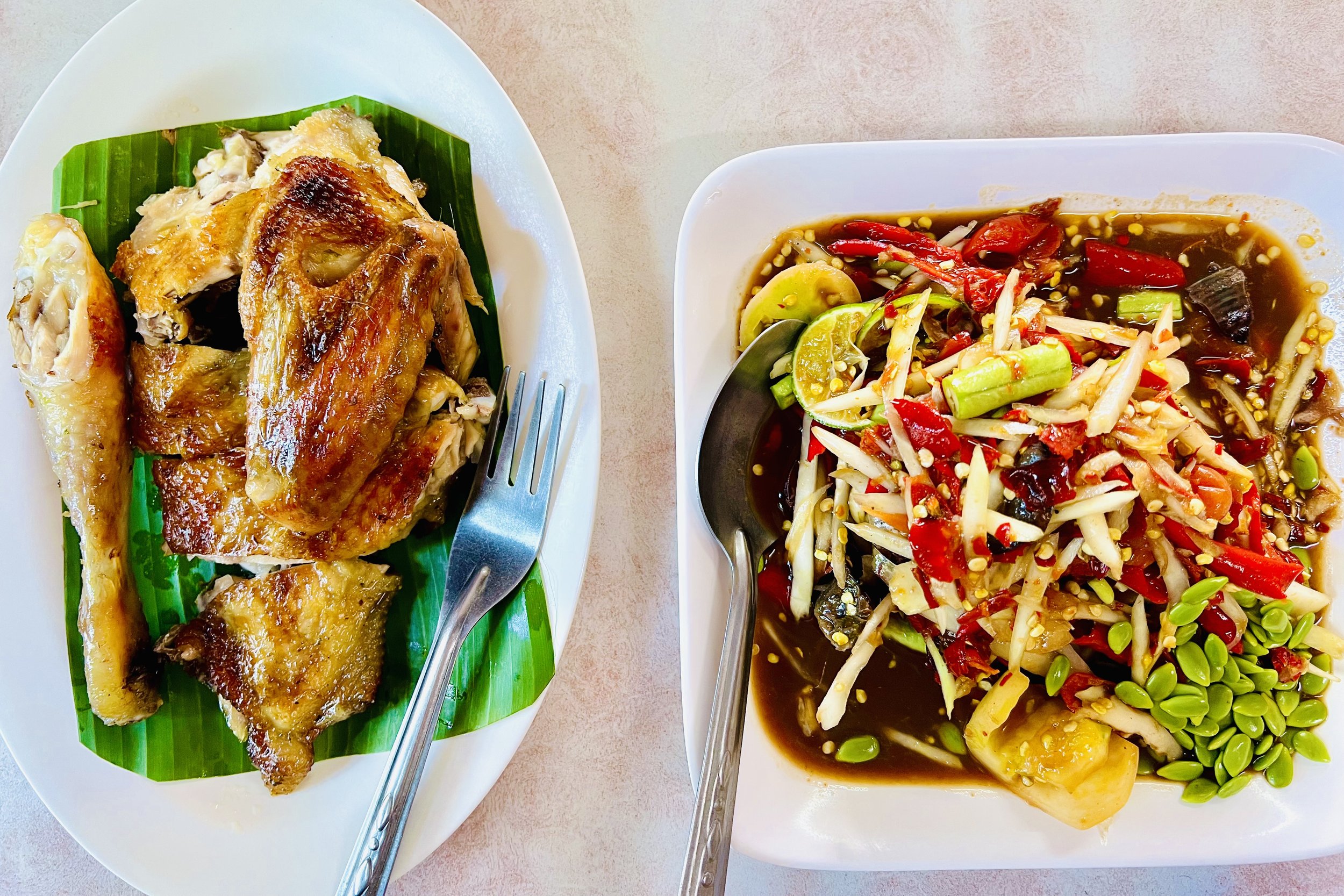
Gai yang and som tam at Santi restaurant. The most Isan meal on a table — and one of the most widely eaten cuisines in the country. The food traveled to Bangkok long before the tourists found their way here.
Isan food now appears on almost every street in Bangkok. Som tam, gai yang, sticky rice — dishes that originated in this region have been adopted nationally and internationally, their heat sometimes softened, their fermentation sometimes smoothed, but their basic logic intact. What you eat in Ubon is the source text. The version Bangkok knows is the translation.
This pattern repeats across the region's exports. Ajahn Chah, born in a village near Ubon, built one of the most significant Theravada Buddhist teaching traditions of the 20th century — drawing monks and practitioners from across the world to a province most of those same practitioners had never heard of. The forest monastery tradition he established, rooted in the landscape east of the city, now has affiliated monasteries on five continents. Ubon's most significant cultural products have traveled everywhere. Ubon itself remains largely undiscovered.
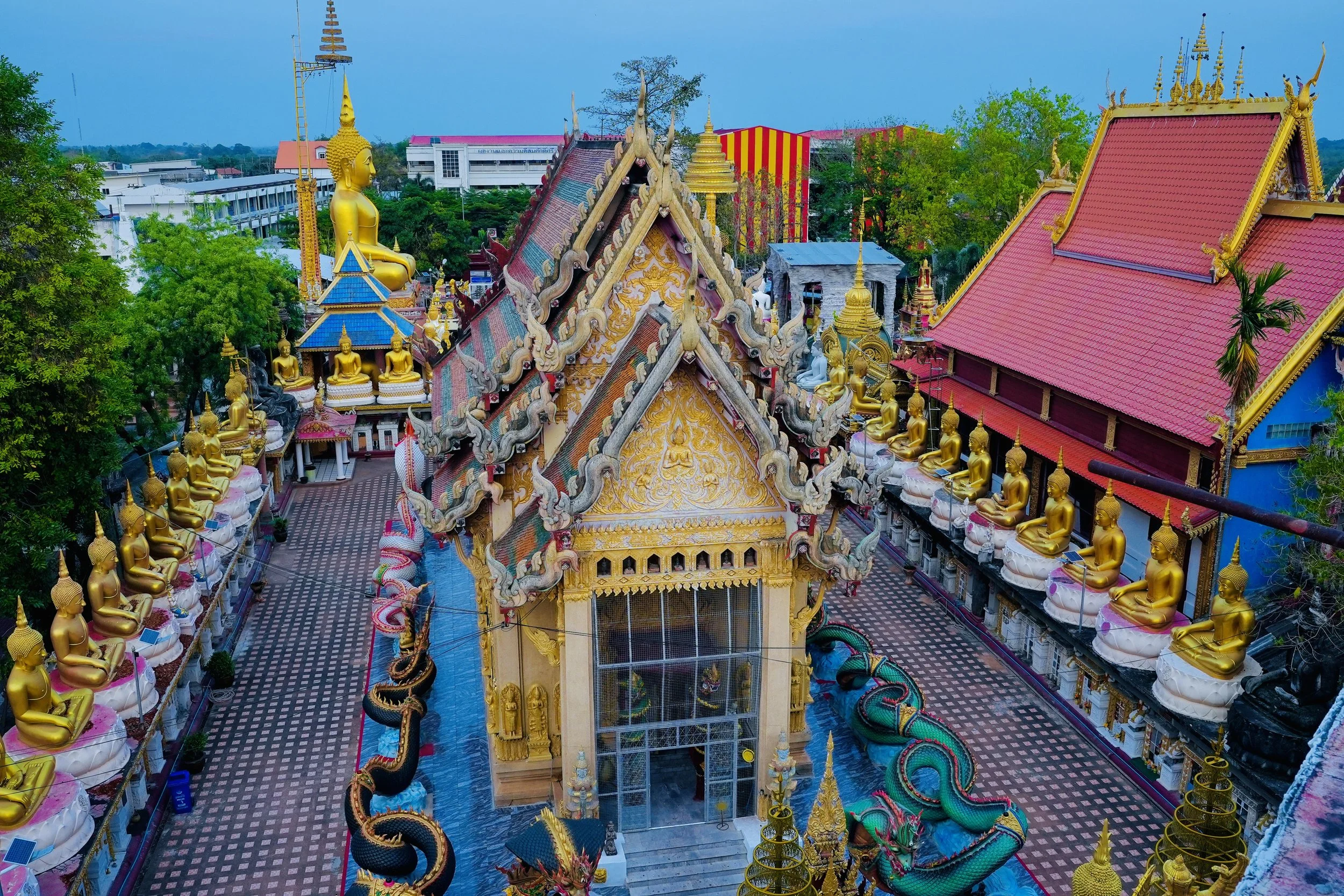
Wat Tai Phrachao Yai Ong Tue from above — rows of golden Buddha images, nagas, guardian figures, rooflines in layers. A city that builds this does not lack for conviction or ambition. It lacks for attention.
The average monthly income in Isan in 2018 was 6,790 baht — roughly half the 12,818 baht average in central Thailand. Household debt in the region stands at around 75 percent of annual income. In 2023, Thailand had 37,559 doctors nationwide, of whom only 8,447 worked across all of Isan's 22 million people. These are the numbers that describe a region that has been systematically underserved by the infrastructure that wealth builds for itself.
They are also numbers that exist alongside something else — something harder to quantify but no less real. The food here is more precise, more complex, more honest than what most of the world knows of Thai cuisine. The architecture here carries a layered history that Bangkok's temples, for all their grandeur, cannot match for sheer accumulation of meaning. The landscape here — the Mekong, the sandstone cliffs, the dry dipterocarp forests, the prehistoric paintings — is among the most remarkable in Southeast Asia. Ubon Ratchathani is not a city waiting to become significant. It already is. The rest of the world simply hasn't caught up.
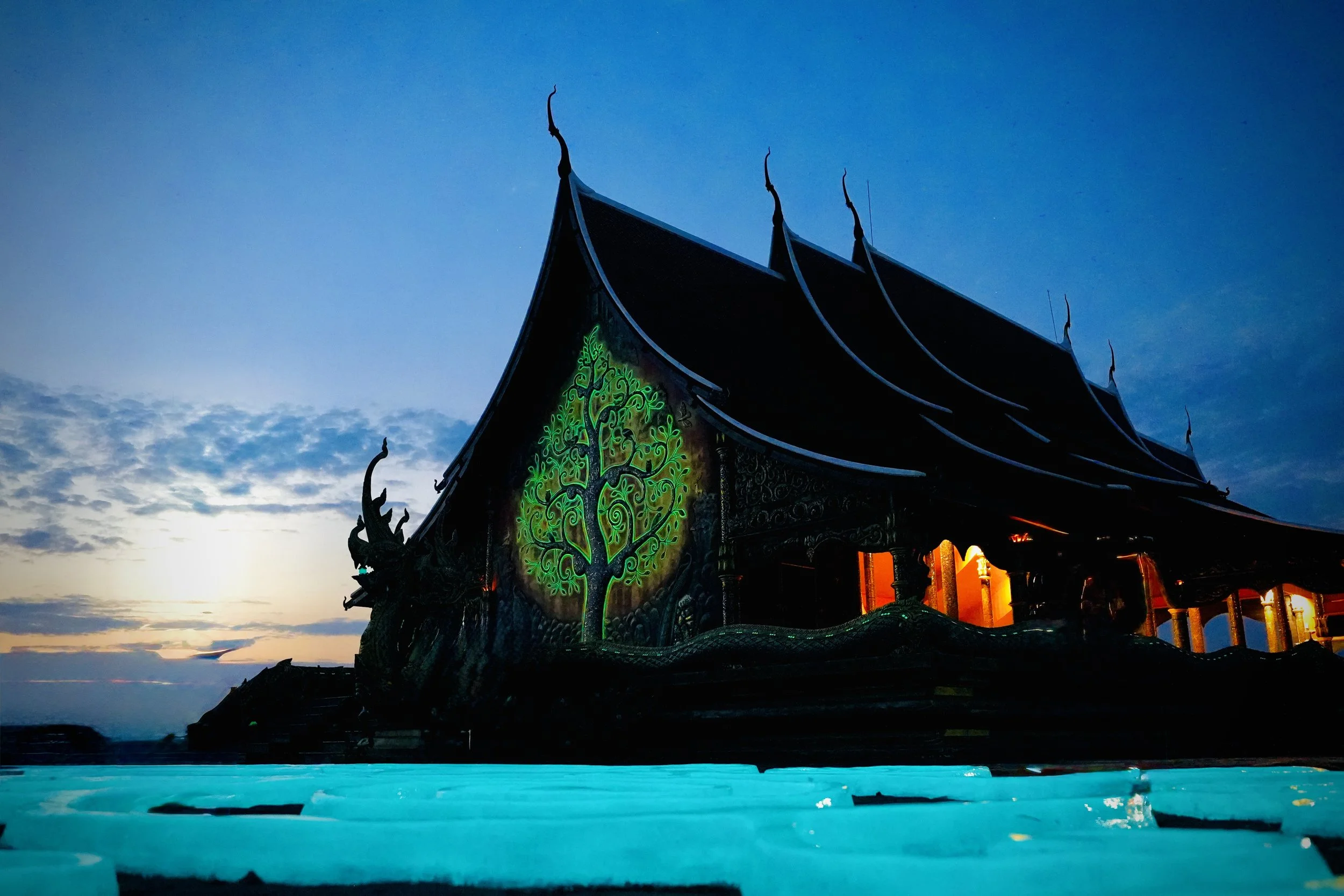
Wat Sirindhorn Wararam Phu Phrao at dusk, its bodhi tree not yet glowing, the sky still holding the last of the day's color. Some places reveal themselves slowly. Ubon Ratchathani is one of them.
The series that began with first impressions ends here — with the numbers that frame a city, and with the understanding that numbers are the beginning of a description, not its conclusion. Ubon Ratchathani is 630 kilometers from Bangkok. It produces the most rice of any province in the country. Its metro population grows at just over one percent a year. Its prehistoric rock paintings are between three and four thousand years old. Isan's per capita income is less than a sixth of Bangkok's.
These are facts. They sketch the outline of a place that has always been more than its outline suggests — a city that arrived from the river inward, not from the capital outward, and that has been building its own significance quietly, in gold leaf and fermented fish and sandstone and forest monasteries and phosphorescent paint, for longer than the statistics have been kept.
The road to Ubon runs out of Thailand. But Ubon itself runs much deeper than the road.
To see more photos & videos from my travels visit the links below
happy traveling,
~Sean
